


Captured from the Hubble Space Telescope, these extraordinary images of the planet Jupiter provide us with an exclusive view of the dynamic weather patterns and notable storms, featuring the Great Red Spot and the Red Spot Jr. The images, obtained on the 5th and 6th of January, 2024, are an integral part of the ongoing Outer Planet Atmospheres Legacy program’s annual assessment that makes salient the volcanic activities and surface features of Io. Credit: NASA, ESA, STScI, Amy Simon (NASA-GSFC)
Tempestuous Cyclones and Violent Storms: Turbulent Atmosphere of Jupiter Unleashed
As the giant amongst its outer planet counterparts, Jupiter, with its iridescent clouds, offers a continually transforming spectacle of shapes and colors. The planet embodies an eternal storm, marked by a succession of cyclones, anticyclones, wind shear, and the colossal storm of the solar system, the Great Red Spot.
Unlike terrestrial planets, Jupiter lacks a solid surface. The planet is uniformly adorned with predominantly ammonia ice-crystal clouds. These relatively thin atmospheric layers, stretching some 30 miles, are the master artists behind Jupiter’s signature striped appearance.
These conspicuous zebra-like bands result from the dual-directional flow of air at varied latitudes, with some wind speeds even reaching a staggering 350 miles per hour. The planet’s chromatic canvas is segmented into alternating light-hued zones, where the atmosphere ascends and dark-hued belts, illustrating regions where the air descends. The collision of these competing flows results in tumultuous storms and turbulence.
The Hubble Space Telescope provides year-round surveillance of these atmospheric metamorphoses with a clarity unparalleled to any other. Capturing colossal storms and fleeting white clouds, the latest images bear evidence of the escalating activity within Jupiter’s atmosphere.

Lining Jupiter are stripes in varying hues of light grey, soft yellow, and brownish-orange, interrupted by large storms and specks of white clouds. The notorious Great Red Spot, the most prominent feature of the planet, situates in the lower third of the image. Not far from the grand tempest, Red Spot Jr., a relatively diminutive but equally intriguing anticyclone, makes an appearance. Another smaller anticyclone dots the upper middle of the planetary view. On the top right, two juxtapositioned storms, a cyclone and an anticyclone, can be noticed. Far on the left edge of the image, lies Jupiter’s minuscule moon Io, displaying a variegated orange surface, indicative of volcanic deposits. Credit: NASA, ESA, Amy Simon (NASA-GSFC)
Closely Trailing Jupiter’s Stormy Weather: An Overview from the Hubble Space Telescope
The magnificent planet Jupiter, clothed in its signature stripes, greets NASA’s Hubble Space Telescope once more in the latest images taken on the 5th and 6th of January, 2024. The images encapsulate both hemispheric views of the celestial body. As part of the Outer Planet Atmospheres Legacy program (OPAL), the Hubble Space Telescope annually monitors Jupiter along with other planets in the outer solar system. Draped in a mix of clouds and hazes whipped up by violent winds, these expansive worlds yield a captivating array of atmospheric transformations.
Launching straight into the planet’s southern hemisphere, one can observe an anticyclone, dubbed the Red Spot Jr., positioned to the lower right of the colossal Great Red Spot. This climatic phenomenon culminated from the fusion of several storms in 1998 and 2000, appearing red for the first time in 2006 before reverting to a less conspicuous beige in subsequent years. The striking red hue’s origin remains a conundrum, postulated to involve a multitude of cyclic chemical compounds, including sulfur, phosphorus, or even organic matter. Following the planet’s latitudinal currents but moving in opposing directions, the Great Red Spot and Red Spot Jr. Astoundingly graze past each other every two years. A smaller red anticyclone can be spotted in the far north of the planet.
Emerging into the opposing hemisphere, we encounter a pair of tempestuous siblings – a deep red cyclone and a reddish anticyclone, huddled near the right of the centre. Radiating such a vivid red, one might easily mistake Jupiter for bearing an celestial abrasion. Reflecting high and low-pressure system patterns, these storms illustrate opposing rotations, with the cyclone exhibiting an upwelling along the edges and descending clouds interiorly causing a clearing of atmospheric haze.
Credit: NASA’s Goddard Space Flight Center, Lead Producer: Paul Morris
Amy Simon, the OPAL project lead stationed at NASA’s Goddard Space Flight Center in Greenbelt, Maryland, anticipates the storms to evade collision due to the repelling effect of their opposing rotations. She emphasises, “The many large storms and small white clouds are indicative of Jupiter’s currently bustling atmospheric activity.”.
Edge closer to the leftmost part of the image to locate the smallest of Galilean moons, Io. Despite its size, Io is the solar system’s most dynamic volcanic body. Hubble manages to decode volcanic deposits scattered across its surface. Probing into blue and violet wavelengths, Hubble unveils surface features that go beyond the standard visual spectrum. This demonstrates the telescope’s continued advancement in space exploration, following up on Voyager 1’s discovery of Io’s distinctive volcanic activity and ‘pizza-like’ appearance in 1979.
The Hubble Space Telescope’s over three-decade-long deployment has paved the path for groundbreaking discoveries and insights into our universe’s complexities. Hubble, the fruit of a joint venture between NASA and the European Space Agency (ESA), is managed by NASA’s Goddard Space Flight Center in Greenbelt, Maryland.
Goddard collaborates with Lockheed Martin Space situated in Denver, Colorado, to handle mission operations. In Baltimore, Maryland, the Space Telescope Science Institute (STScI) conducts scientific operations for both Hubble and Webb on behalf of NASA. The institute is operated by the Association of Universities for Research in Astronomy, headquartered in Washington, D.C.
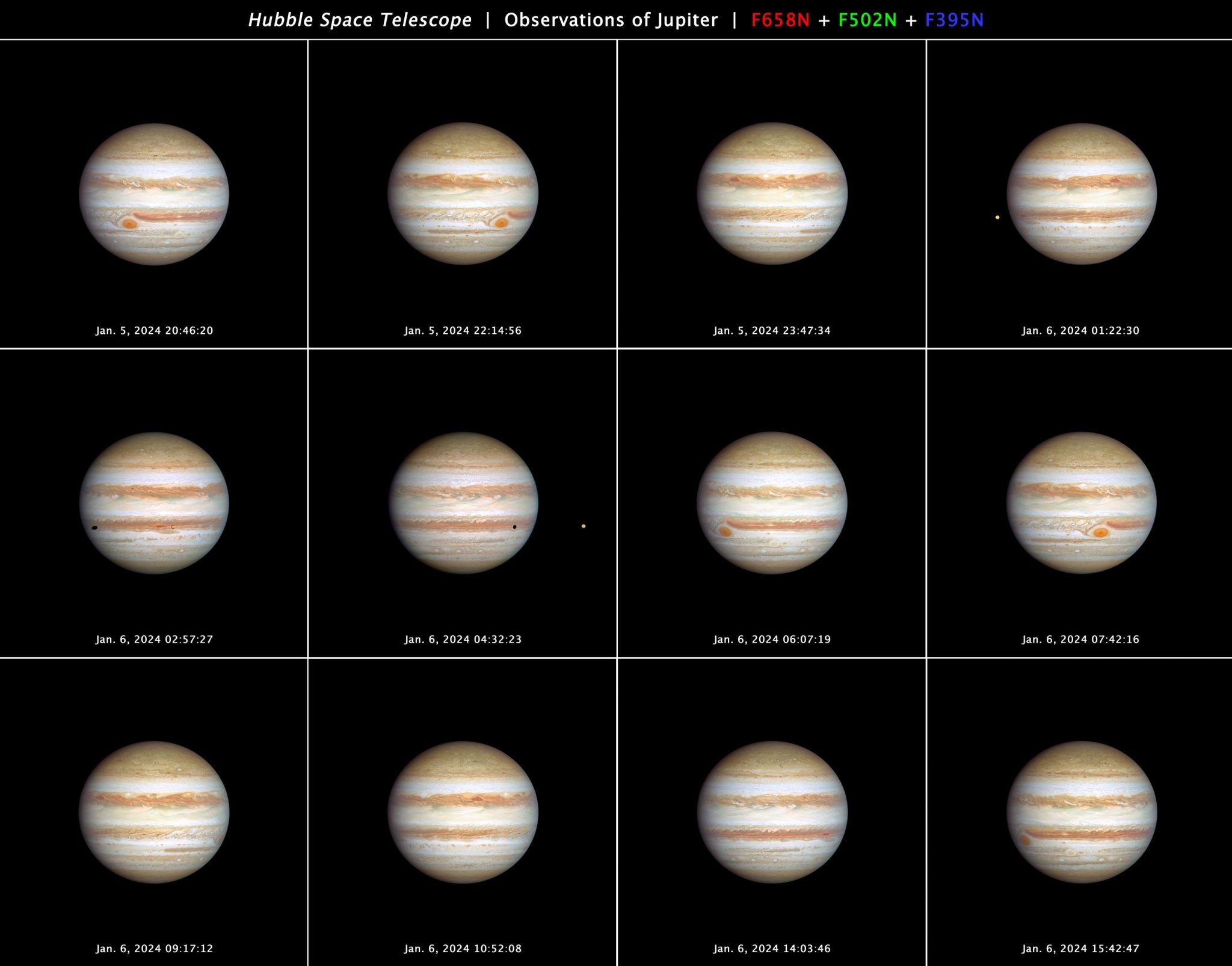
This 12-panel Hubble image sequence portrays a complete rotation of the colossal Jupiter. The Great Red Spot provides a reliable indicator of the planet’s true rotational time of nearly 10 hours. In several frames, the innermost Galilean moon, Io, is observable along with its shadow dancing over the tops of Jupiter’s cloud cover. Hubble, under the auspices of the Outer Planet Atmospheres Legacy program (OPAL), keeps a dutiful watch over Jupiter and the outer planets of the solar system year after year. Credit: Amy Simon (NASA-GSFC)
Vocabulary List:
- Iridescent (adjective): Displaying a play of lustrousrainbow-like colors.
- Atmosphere (noun): The envelope of gases surrounding a planet or other celestial body.
- Anticyclone (noun): A circulation of winds around a central region of high atmospheric pressure.
- Colossal (adjective): Extremely large or great.
- Astounding (adjective): Surprisingly impressive.
- Conspicuous (adjective): Easily seen or noticed obvious.



