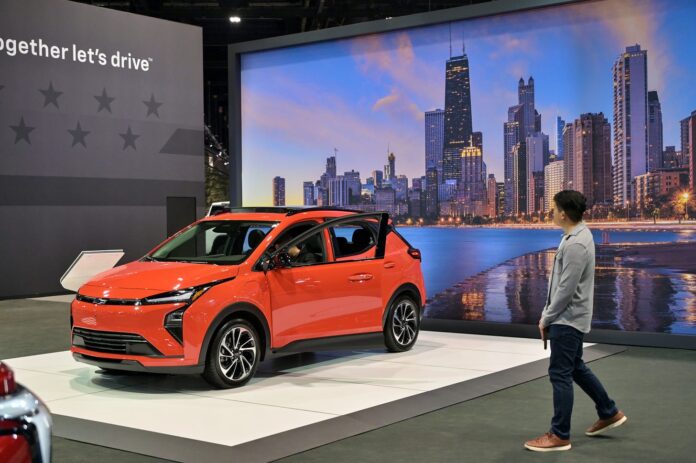
General Motors has recently unveiled the 2027 Chevrolet Bolt, an all-electric subcompact car ideally suited for the current economic climate. Its affordability allows drivers to bypass gas stations amid soaring fuel prices exacerbated by the ongoing conflict in Iran.
However, interested buyers should act quickly, as the vehicle’s availability may be short-lived. GM has confirmed that production of the Bolt will cease next year, with plans to repurpose its factory in Kansas City for manufacturing vehicles that use internal combustion engines.
GM asserts that its decision to limit the Bolt was made some time ago, while maintaining a commitment to other electric vehicles (EVs). This statement appears to hold some truth, yet it is evident that GM has scaled back its broader EV aspirations. The company has shelved plans to convert additional factories for EV production. Similarly, other manufacturers, including Honda, have recently announced the cancellation of several planned EV models in the United States.
The reasons for this industry-wide pullback are complex, with a significant factor being the policies enacted by former President Donald Trump. He has worked to eliminate tax incentives for EV production and purchase, alongside weakening federal and state emissions standards that favoured fuel efficiency. This multifaceted policy reversal has put additional pressure on the automotive sector.
Despite these challenges, rising gas prices have prompted an increase in consumer interest regarding electric vehicles. As the current economic situation persists, many Americans are likely to seek alternatives that manufacturers are increasingly unable to supply.
In contrast to past experiences—such as the oil crises of the 1970s—American automakers now face a similar predicament, albeit with the added challenge of diminished production capacity for vehicles that meet consumer demand for fuel efficiency.
Test Your Understanding
How much do you know?