Warning: foreach() argument must be of type array|object, false given in /home/u750883576/domains/esl-news.com/public_html/wp-content/plugins/gpt-post-quiz/includes/admin/class-gpoq-admin-4.php on line 450
Warning: foreach() argument must be of type array|object, false given in /home/u750883576/domains/esl-news.com/public_html/wp-content/plugins/td-composer/legacy/common/wp_booster/td_menu.php on line 88
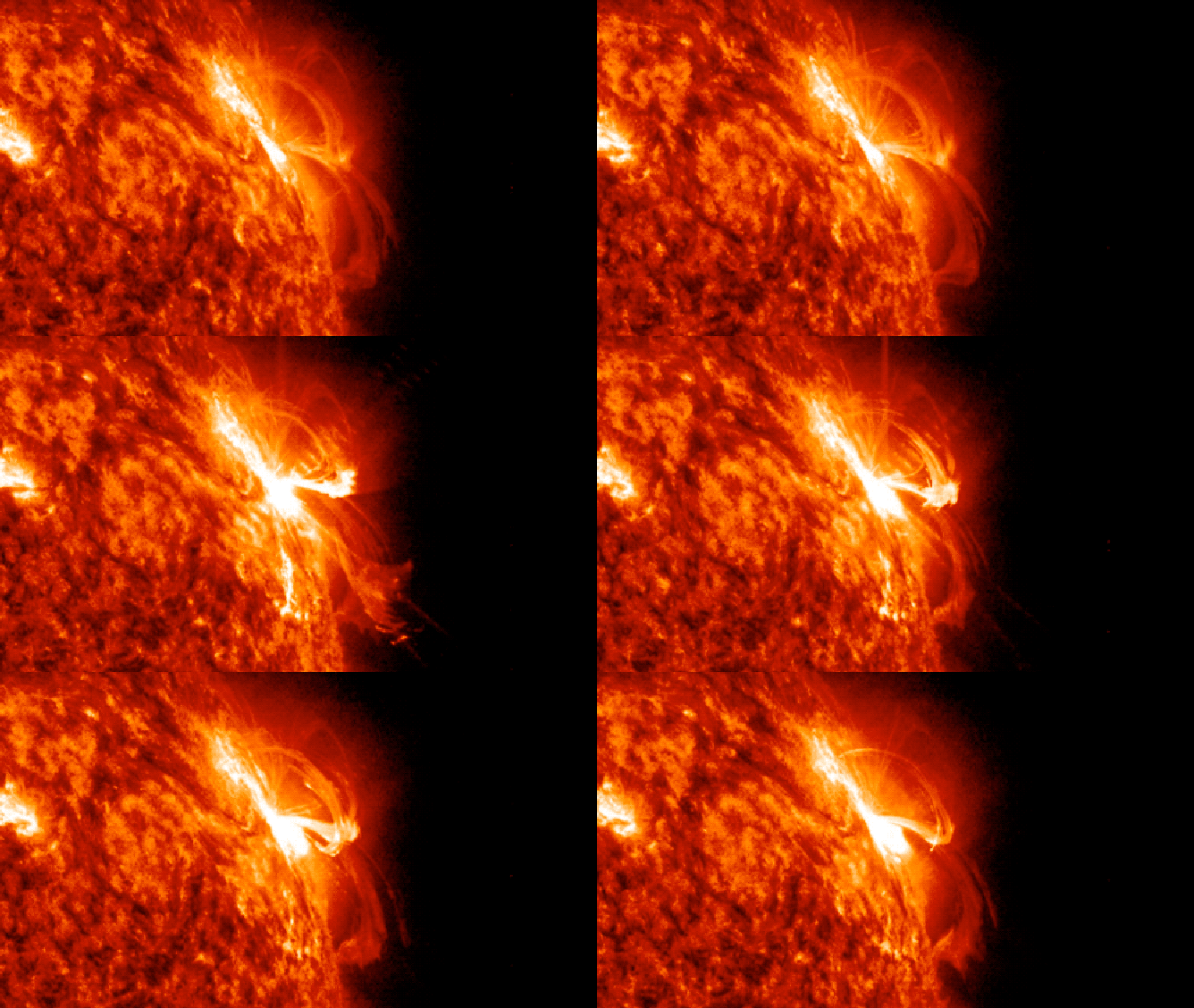
NASA’s Solar Dynamics Observatory reported a significant solar flare from the Sun on 3 February. This event, following several eruptions, could lead to geomagnetic disturbances, which may enhance the Northern Lights.
Researchers at the American Geophysical Union (AGU) are studying geomagnetic storms to find ways to lessen their impact. These storms happen when the Sun produces tangled magnetic fields, affecting technology both in space and on Earth. Solar flares are powerful energy bursts that can disrupt radio communications, electric grids, and navigation systems. They can also pose risks to spacecraft and astronauts, according to NASA.
Experts suggest creating an artificial mass-loading system in Earth’s magnetosphere to strengthen protection against solar storms. This system would involve launching spacecraft that release special materials into space. These materials would help shield the planet by reducing the effects of solar winds, particularly during strong solar events.
Once released, the materials would quickly interact with the magnetosphere, creating a plasma shield. This shield would significantly lower the impact of solar storms, claiming over a 50% reduction in effects. The goal is to ensure real-time protection for satellites and to prevent outages on Earth.
This innovative approach could improve how we protect our technology and enhance safety as we explore space further.
Test Your Understanding
Start Quiz
Vocabulary List:
6 words · tap to reveal
ON
Accent
flare/flɛr/noun
a sudden bright burst of light and energy
geomagnetic/ˌdʒiːoʊmæɡˈnɛtɪk/adjective
connected with Earth's magnetic field and activity
magnetosphere/ˌmæɡnəˈtoʊsfɪr/noun
the region around Earth controlled by its magnetic field
What date did NASA's Solar Dynamics Observatory report a significant solar flare?
1 February
2 February
3 February
4 February
What do geomagnetic storms primarily affect?
Only Earth
Only space technology
Both space and Earth technology
None of the above
What is one purpose of the artificial mass-loading system suggested by experts?
To create more solar flares
To strengthen protection against solar storms
To eliminate geomagnetic storms
To enhance solar eruptions
What is a key component of the plasma shield mentioned in the content?
Solid materials
Liquid metals
Special materials released by spacecraft
None of the above
Over what percentage reduction in effects of solar storms is claimed by the plasma shield approach?
30%
40%
50%
60%
Which organization is mentioned as studying geomagnetic storms?
NASA
AGU
ESA
NOAA
The solar flare reported on 3 February was the first event of its kind in 2023.
Geomagnetic storms can disrupt technology both in space and on Earth.
Experts have suggested using a passive system to protect against solar storms.
The plasma shield is designed to enhance satellite protection.
NASA aims to find ways to increase the effects of solar winds.
Solar flares pose risks only to astronauts, not to spacecraft.
NASA’s Solar Dynamics Observatory reported a significant solar flare on 3 February following several eruptions that could lead to geomagnetic disturbances, which may enhance the Northern Lights. The researchers are studying storms.
The artificial mass-loading system would involve launching spacecraft that release special materials into .
These materials would help shield the planet by reducing the effects of solar winds, particularly during solar events.
Once released, the materials would quickly interact with the magnetosphere, creating a shield.
The goal of this innovative approach is to ensure protection for satellites.
The plasma shield aims for over a 50% reduction in the effects of solar .
What date did NASA's Solar Dynamics Observatory report a significant solar flare?
1 February
2 February
3 February
4 February
What do geomagnetic storms primarily affect?
Only Earth
Only space technology
Both space and Earth technology
None of the above
What is one purpose of the artificial mass-loading system suggested by experts?
To create more solar flares
To strengthen protection against solar storms
To eliminate geomagnetic storms
To enhance solar eruptions
What is a key component of the plasma shield mentioned in the content?
Solid materials
Liquid metals
Special materials released by spacecraft
None of the above
Over what percentage reduction in effects of solar storms is claimed by the plasma shield approach?
30%
40%
50%
60%
Which organization is mentioned as studying geomagnetic storms?
NASA
AGU
ESA
NOAA
The solar flare reported on 3 February was the first event of its kind in 2023.
Geomagnetic storms can disrupt technology both in space and on Earth.
Experts have suggested using a passive system to protect against solar storms.
The plasma shield is designed to enhance satellite protection.
NASA aims to find ways to increase the effects of solar winds.
Solar flares pose risks only to astronauts, not to spacecraft.
NASA’s Solar Dynamics Observatory reported a significant solar flare on 3 February following several eruptions that could lead to geomagnetic disturbances, which may enhance the Northern Lights. The researchers are studying storms.
The artificial mass-loading system would involve launching spacecraft that release special materials into .
These materials would help shield the planet by reducing the effects of solar winds, particularly during solar events.
Once released, the materials would quickly interact with the magnetosphere, creating a shield.
The goal of this innovative approach is to ensure protection for satellites.
The plasma shield aims for over a 50% reduction in the effects of solar .