

Saturday, March 14, 2026

NASA Orbiter Detects First Confirmed Lightning on Mars

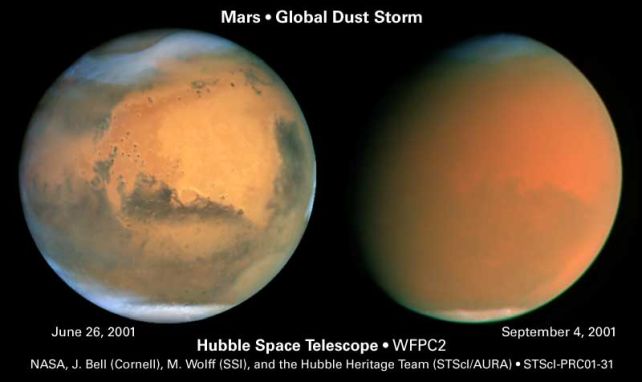
Planetary scientists have long studied the huge dust storms on Mars and wondered if they could create electricity. These storms can cover the entire planet and move millions of tons of sand through a thin atmosphere. On Earth, similar situations, like volcanic eruptions or desert winds, often lead to strong electrical discharges.

Researchers had searched for signs of electricity, like flashes of light or radio signals, but had little success. Even during Mars’ fiercest seasonal storms, the sky remained dark. In late 2024, a special instrument in orbit around Mars began detecting a specific kind of signal. This sensor was tuned to low-frequency electromagnetic waves, which need unique atmospheric conditions to exist.

The MAVEN spacecraft, which has been observing Mars since 2014, helped in this discovery. This spacecraft has an instrument called the Langmuir Probe, designed to study the upper atmosphere and its interaction with solar wind. A team from the Swedish Institute of Space Physics, led by Dr. David Andrews, found a clear signal that matched a phenomenon known as a lightning whistler.

This finding is significant as it is the first detection of this type of wave on Mars, suggesting that lightning does occur during dust storms. These storms likely create static electricity when dust particles rub against each other. MAVEN monitored the signal at a height where Mars’ unique magnetic field allowed these waves to escape into space.

Vocabulary List:
6 words · tap to reveal
OFF

AccentSpeed

electromagnetic/ɪˌlɛktroʊˈmæɡnɛtɪk/adjective
Relating to electric and magnetic fields or their interactions; describing waves made of combined electric and magnetic components.

low-frequency/loʊ ˈfriːkwənsi/adjective
Having a low rate of oscillation (few cycles per second); describing waves with long wavelengths and low energy.

whistler/ˈwɪslər/noun
A specific type of low-frequency electromagnetic wave produced by lightning and guided along a planet’s magnetic field lines; detected as a characteristic signal by instruments.

static electricity/ˌstætɪk ɪˌlɛktrɪˈsɪti/noun
Electric charge that builds up on surfaces often produced when materials rub together; a likely source of electrical activity in dust storms.

solar wind/ˈsoʊlər wɪnd/noun
A stream of charged particles (plasma) emitted from the Sun’s outer atmosphere that interacts with planetary atmospheres and magnetic fields.

magnetic field/mæɡˈnɛtɪk fiːld/noun
The region around a magnet or moving electric charge where magnetic forces act; on planets it can guide charged particles and allow certain waves to travel into space.
Vocabulary List:
6 words · tap to reveal
OFF
AccentSpeed
electromagnetic/ɪˌlɛktroʊˈmæɡnɛtɪk/adjective
Relating to electric and magnetic fields or their interactions; describing waves made of combined electric and magnetic components.
low-frequency/loʊ ˈfriːkwənsi/adjective
Having a low rate of oscillation (few cycles per second); describing waves with long wavelengths and low energy.
whistler/ˈwɪslər/noun
A specific type of low-frequency electromagnetic wave produced by lightning and guided along a planet’s magnetic field lines; detected as a characteristic signal by instruments.
static electricity/ˌstætɪk ɪˌlɛktrɪˈsɪti/noun
Electric charge that builds up on surfaces often produced when materials rub together; a likely source of electrical activity in dust storms.
solar wind/ˈsoʊlər wɪnd/noun
A stream of charged particles (plasma) emitted from the Sun’s outer atmosphere that interacts with planetary atmospheres and magnetic fields.
magnetic field/mæɡˈnɛtɪk fiːld/noun
The region around a magnet or moving electric charge where magnetic forces act; on planets it can guide charged particles and allow certain waves to travel into space.

Read More
