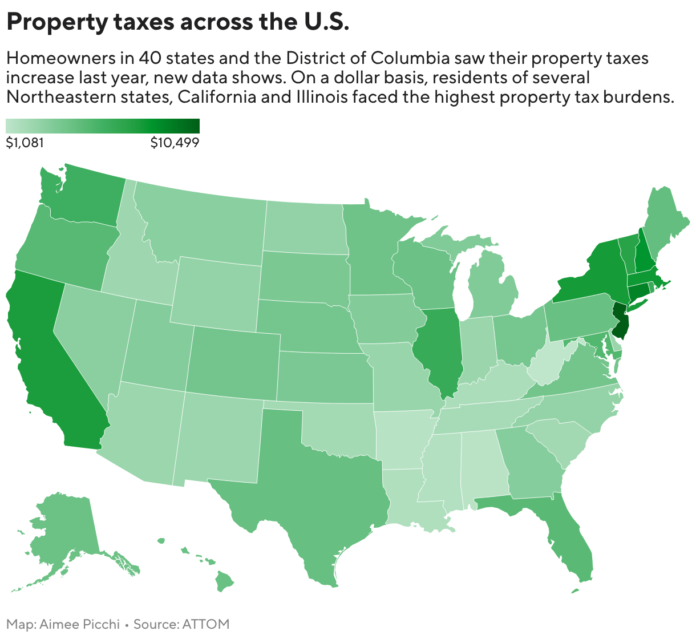
Property taxes in the United States are increasing faster than inflation. Last year, the average homeowner paid $4,427, which is a 3.7% rise from 2024. In comparison, the Consumer Price Index, which measures the price of commonly bought goods, increased by only 2.7%.
These taxes are usually collected by local governments to fund services such as schools and public safety. They account for 70% of local tax collections, according to the Tax Foundation, a nonpartisan group. In some states, homeowners saw even larger tax increases, such as an 18% rise in Delaware and an 11.6% rise in Maryland.
Interestingly, property taxes went up even when the average value of single-family homes dropped by 1.7% to about $494,231. This suggests that local governments are raising taxes due to the higher costs of providing services, not just property values.
ATTOM’s CEO, Rob Barber, explained that property taxes often increase because local governments need more money for schools and infrastructure, regardless of broader inflation rates. While property taxes rose in 40 states, they decreased in 10, including Wyoming, which approved a 25% tax cut for homes valued at up to $1 million.
Homeowners in the Northeast and California typically pay the highest property taxes, while West Virginia has the lowest average at $1,081.
Test Your Understanding
How much do you know?