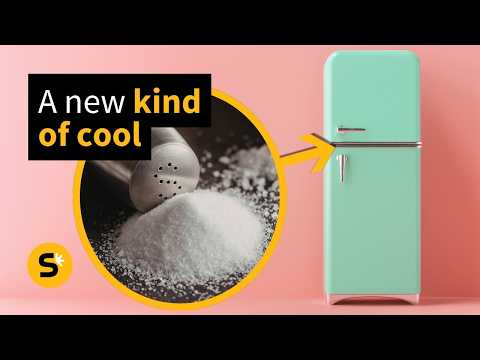
Ionocaloric cooling is a new method for reducing temperatures, potentially offering a safer and environmentally friendly alternative to traditional refrigeration.
Standard cooling systems use fluids that absorb heat when they change from a liquid to a gas and then back to a liquid. However, the refrigerants used in these systems can harm the environment.
In 2023, researchers from the Lawrence Berkeley National Laboratory and the University of California, Berkeley, developed a method that exploits how materials store or release energy during phase changes, such as when ice melts.
Adding ions, or charged particles, can force ice to melt and absorb heat without increasing temperature. This is seen when salt prevents ice formation on roads. The ionocaloric cycle applies a similar principle, using salt to change a fluid’s state and produce cooling.
Mechanical engineer Drew Lilley noted that while there are ongoing refrigerant issues, the ionocaloric cycle might address efficiency, safety, and environmental concerns successfully.
The researchers demonstrated that their method could potentially rival current refrigerants by adjusting the melting point using an electric current. Their experiments with iodine and sodium in ethylene carbonate show a significant 25 °C temperature change with less than one volt of electricity.
Ravi Prasher highlighted the potential advantages of this technology regarding environmental impact, efficiency, and cost. Countries committed to reducing hydrofluorocarbons (HFCs) might benefit from this innovation.
The next step is to move the technology from the lab to real-world applications. Researchers are testing various salts to improve heat absorption, with promising results published in 2025 on nitrate-based salts. Prasher emphasizes the need for further experimentation to address engineering challenges.
These findings were published in the journal Science.
Test Your Understanding
Start Quiz
Vocabulary List:
6 words · tap to reveal
OFF
AccentSpeed
Ionocaloric/aɪ.oʊ.noʊ.kəˈlɒrɪk/noun
A cooling method that uses the addition or removal of ions to change a material’s phase and absorb or release heat.
Refrigerants/rɪˈfrɪdʒərənts/noun (plural)
Fluids used in cooling systems that absorb heat when they evaporate and release heat when they condense.
Ions/ˈaɪənz/noun (plural)
Charged particles (positive or negative) that affect chemical and physical processes; in the article added to cause melting or freezing changes.
Phase change/feɪz ʧeɪndʒ/noun (phrase)
A change between solid liquid and gas states (e.g. melting or freezing) during which a material absorbs or releases energy.
Melting point/ˈmɛltɪŋ pɔɪnt/noun (phrase)
The temperature at which a solid becomes a liquid.