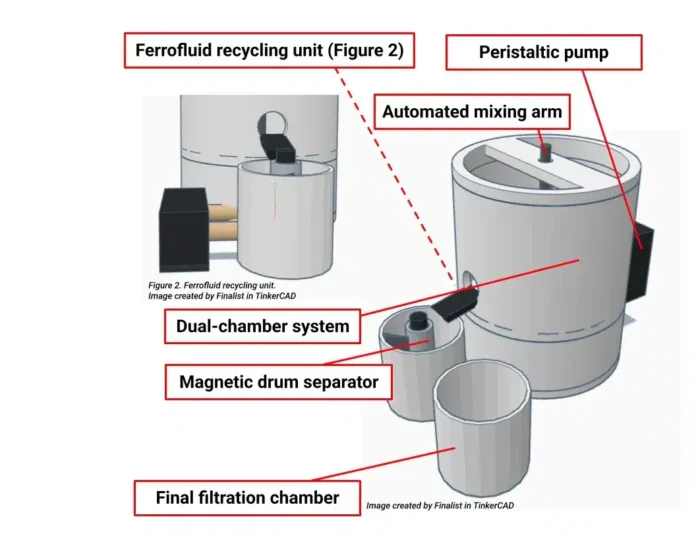
A high school student in Virginia has successfully developed a filtration system that eliminates over 95 percent of microplastics from drinking water. This innovation employs a magnetic liquid known as ferrofluid to extract tiny plastic particles from water without using conventional filter membranes.
The emergence of microplastics, which are synthetic particles measuring between 1 nanometre and 5 millimetres, has garnered increasing concern, as they have been detected in various environments, including oceans and human organs. Although research continues into their health impacts, their pervasive presence is worrisome.
In Warrenton, Virginia, reports of water contamination, specifically due to polytetrafluoroethylene substances (PFAS) and microplastics, prompted residents to seek personal solutions for water filtration. This situation motivated Mia Heller, a student at Kettle Run High School, to explore alternative filtration methods.
Heller began her project at home, where her family had previously used a filtration system that required frequent maintenance. Frustrated by the need for constant filter replacements, she aimed to create a simpler and more efficient solution. Her invention evolved into a three-chamber system that separates water, ferrofluid, and microplastics, utilising a magnetic field to extract contaminants from the water. Importantly, the ferrofluid can be reused, eliminating the need for disposable components.
The alarming spread of microplastics is reflected in research that reveals their presence in over 1,300 species and even human tissues, including the brain and bones. A University of New Mexico study indicated a 50 percent increase in microplastic levels in human brain samples within a decade, raising questions about potential health risks.
Heller’s prototype achieved a remarkable 95.52 percent removal rate of microplastics while reclaiming 87.15 percent of the ferrofluid. These results place her system on par with traditional water treatment plants, which typically eliminate between 70 and 90 percent of microplastics. However, challenges remain regarding the safe disposal of collected microplastics and the cost of producing ferrofluid at scale.
Heller envisages her system as suitable for domestic use, specifically under kitchen sinks, rather than in large treatment facilities. She plans to have her findings validated by professionals before determining the next steps in her project.
Test Your Understanding
How much do you know?