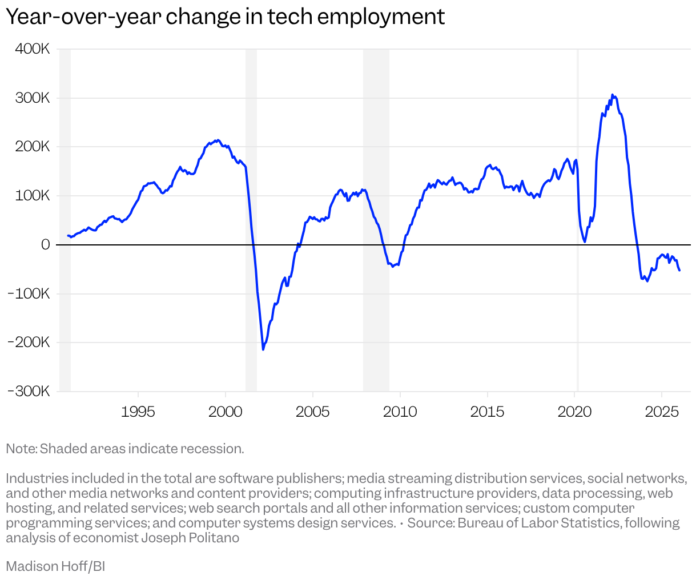
February’s jobs report revealed a concerning loss of 92,000 positions across the US economy, significantly lower than the forecast of a 55,000 increase. Economist Joseph Politano highlighted the tech industry’s struggles, indicating that it has faced extraordinary challenges over the past few years.
Historically, the tech sector typically sees an annual increase of 100,000 to 300,000 jobs. However, this trend has reversed, with job losses now exceeding those observed during downturns in 2008 and 2020. Politano describes the current situation as distinctly worse than the 2020 recession and somewhat more severe than in 2008, drawing parallels with the dot-com crash.
Cory Stahle, an economist at the Indeed Hiring Lab, noted that the downturn is not exclusive to tech; manufacturing and government sectors are also experiencing job losses. Even healthcare, which previously supported job growth, saw a decline in February, partly due to a significant strike.
According to Nicole Bachaud from ZipRecruiter, the job market’s recent downturn aligns with ongoing trends, although the layoff rate remains stable overall. However, new graduates entering STEM fields may struggle to find jobs amid reduced hiring in tech.
The recent job figures do not yet include substantial layoffs from the company Block, which cut nearly half its workforce last week. CEO Jack Dorsey attributed these cuts to advancements in artificial intelligence (AI), a factor that Politano believes may contribute to tech job losses. He warned that without clear evidence of an economic turnaround, the tech sector may continue to face challenges in the near future.
Test Your Understanding
Start Quiz
Vocabulary List:
6 words · tap to reveal
OFF
AccentSpeed
Recession/rɪˈsɛʃən/noun
A period of economic decline when production employment and spending fall.
Downturn/ˈdaʊnˌtɜrn/noun
A decline or worsening in economic or business conditions.
Layoffs/ˈleɪˌɔfs/noun (plural)
Job losses when employers let workers go often for financial or structural reasons.