Monday, March 16, 2026

Curiosity Rover Lands on New Mars Spot, Makes Key Discovery

NASA’s Curiosity rover has reached a safe parking spot on Mars called “Laguna del Bayo.” This location allows scientists to study Mars’ geological features in detail. The new spot is stable, meaning Curiosity can use its tools without fear of moving or falling.

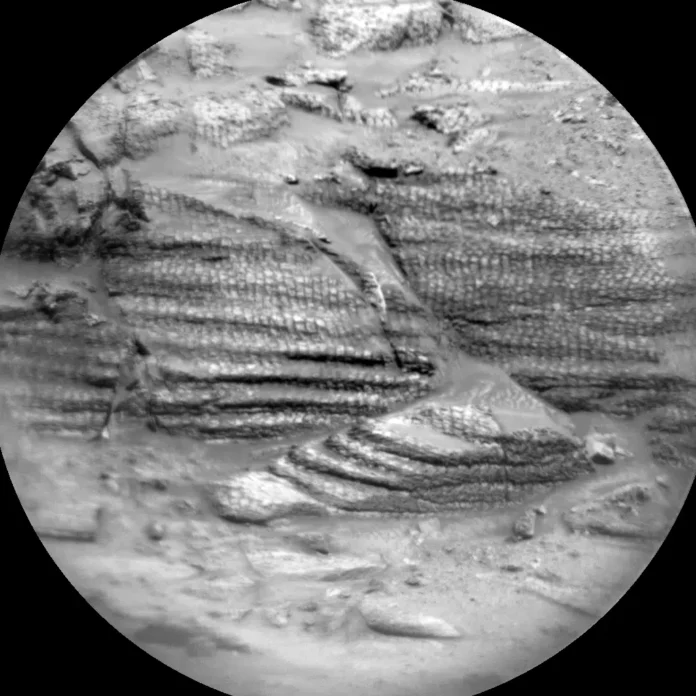
The site has interesting geology, possibly holding unique rock formations known as “boxwork.” Scientists believe these formations could give important clues about Mars’ past environment and any signs of life that may have existed there.

In this location, Curiosity will analyse local rocks, especially one called “Tarija.” The rover’s APXS tool will collect data about the chemical makeup of the rocks. This information helps scientists understand how Mars has changed over millions of years.

Curiosity will also take high-resolution images of the area around it. These images will help map the planet’s geological history. Additionally, the rover will monitor the Martian atmosphere. This includes measuring dust levels, which is important for future missions.

With a planned 54-meter drive ahead, Curiosity will gather even more information. These efforts will help scientists learn more about Mars, supporting future human exploration of the planet.

Test Your Understanding

Start Quiz

How much do you know?

What is the name of the safe parking spot on Mars where Curiosity has landed?
Valley of Gale
Laguna del Bayo
Olympus Mons
Valles Marineris
What type of geological formations might be found at Laguna del Bayo?
Fossils
Boxwork
Sedimentary rocks
Volcanic rocks
What tool will Curiosity use to collect data about the chemical makeup of rocks?
Rover Arm
ChemCam
APXS
MastCam
What is Curiosity planning to do with the local rocks?
Bury them
Analyse them
Throw them
Take them to Earth
What is the planned distance Curiosity will drive at the new location?
10 meters
20 meters
54 meters
100 meters
What will Curiosity take high-resolution images of?
The Surface of Mars
The Martian moons
The stars
Earth from Mars
Curiosity can use its tools without fear of moving or falling at Laguna del Bayo.
Boxwork formations are believed to provide clues about Mars' current environment.
Curiosity is capable of monitoring the Martian atmosphere.
Laguna del Bayo is an unstable location for the Curiosity rover.
The rover will not take any images of its surroundings.
The study of local rocks may give insights into the possibility of life on Mars.
Curiosity has reached a safe parking spot on Mars called .
Curiosity will analyse local rocks, especially one called .
The site has unique rock formations known as .
Curiosity will measure dust levels in the .
The APXS tool will collect data about the makeup of the rocks.
Curiosity will gather information to support future of Mars.
This question is required

Test Your Understanding

Start Quiz

How much do you know?

What is the name of the safe parking spot on Mars where Curiosity has landed?
Valley of Gale
Laguna del Bayo
Olympus Mons
Valles Marineris
What type of geological formations might be found at Laguna del Bayo?
Fossils
Boxwork
Sedimentary rocks
Volcanic rocks
What tool will Curiosity use to collect data about the chemical makeup of rocks?
Rover Arm
ChemCam
APXS
MastCam
What is Curiosity planning to do with the local rocks?
Bury them
Analyse them
Throw them
Take them to Earth
What is the planned distance Curiosity will drive at the new location?
10 meters
20 meters
54 meters
100 meters
What will Curiosity take high-resolution images of?
The Surface of Mars
The Martian moons
The stars
Earth from Mars
Curiosity can use its tools without fear of moving or falling at Laguna del Bayo.
Boxwork formations are believed to provide clues about Mars' current environment.
Curiosity is capable of monitoring the Martian atmosphere.
Laguna del Bayo is an unstable location for the Curiosity rover.
The rover will not take any images of its surroundings.
The study of local rocks may give insights into the possibility of life on Mars.
Curiosity has reached a safe parking spot on Mars called .
Curiosity will analyse local rocks, especially one called .
The site has unique rock formations known as .
Curiosity will measure dust levels in the .
The APXS tool will collect data about the makeup of the rocks.
Curiosity will gather information to support future of Mars.
This question is required

Read More