

Tuesday, April 7, 2026

Gut Protein Shown to Neutralise Harmful Bacteria

Researchers have identified a specific protein in the gut that plays a key role in combating the spread of bacteria. This discovery could lead to potential treatments for conditions like inflammatory bowel disease.

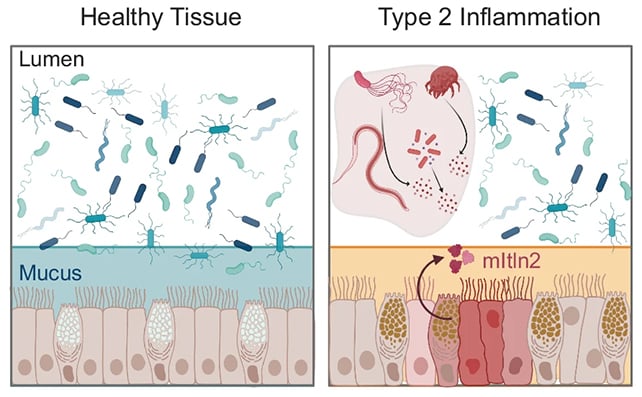
The protein, known as intelectin-2, has been recognised by scientists, but its specific function within the gastrointestinal (GI) tract was previously unclear. Intelectin-2 is classified as a lectin, a type of protein that binds to particular sugar molecules.

A team from the Massachusetts Institute of Technology (MIT) has revealed that intelectin-2 operates in two ways. Firstly, it connects mucus molecules that line the GI tract, enhancing the protective mucus barrier around intestinal tissues. Secondly, if the barrier is breached, intelectin-2 identifies and traps various bacterial cells, either inhibiting their growth or killing them outright.

This dual action of intelectin-2 serves both defensive and offensive purposes for maintaining health. Researchers employed multiple methods to examine the protein’s activity, including studies on mouse tissue, gut bacteria from both mice and humans, and the human and mouse versions of the protein in a laboratory setting.

Notably, intelectin-2 targets galactose, a simple sugar present in mucus and on the surface of some bacterial cells associated with GI infections. When intelectin-2 binds to and traps these bacteria, they appear to deteriorate over time, presumably due to damage to their outer membranes.

Importantly, some bacteria that intelectin-2 neutralises are resistant to antibiotics, which enhances the significance of this research for drug development.

The scientists believe that intelectin-2’s abilities could lead to innovative treatments, either by developing drugs that mimic its actions or by enhancing its functions within the body. Their findings were published in Nature Communications.

Test Your Understanding

Start Quiz

Vocabulary List:
6 words · tap to reveal
ON

Accent

lectin/ˈlɛktɪn/noun
a protein that binds specific sugar molecules

mucus/ˈmjuːkəs/noun
a slippery substance that lines some body parts

barrier/ˈbæriər/noun
something that blocks or protects an area

breached/briːtʃt/adjective
broken so protection is no longer effective

galactose/ɡəˈlæktoʊs/noun
a simple sugar found in some foods and cells

resistant/rɪˈzɪstənt/adjective
not easily affected or killed by something

How much do you know?

What type of protein is intelectin-2 classified as?
Enzyme
Hormone
Lectin
Antibody
Which institution's team conducted the research on intelectin-2?
Harvard University
Stanford University
Massachusetts Institute of Technology
California Institute of Technology
What is one of the primary functions of intelectin-2?
Binding to fatty acids
Enhancing protective mucus barrier
Stimulating insulin production
Absorbing nutrients
What simple sugar does intelectin-2 target?
Glucose
Fructose
Galactose
Sucrose
What could intelectin-2's abilities potentially lead to in terms of treatments?
Vaccines
Antibiotics
Innovative drug treatments
Surgical procedures
In which journal were the findings on intelectin-2 published?
Science
Nature
Nature Communications
The Lancet
Intelectin-2 is only involved in protecting the intestinal tissues without any offensive action.
The research on intelectin-2 included studies on both mouse and human tissues.
Galactose is not found in mucus but is targeted by intelectin-2.
Intelectin-2 can neutralise some antibiotic-resistant bacteria.
The specific function of intelectin-2 was clear to scientists before the recent research.
The dual action of intelectin-2 serves to maintain health.
Researchers have identified a specific protein in the gut known as .
Intelectin-2 enhances the protective mucus barrier around intestinal .
When intelectin-2 binds to bacteria, they appear to deteriorate over .
Intelectin-2's dual actions include connecting mucus molecules and bacterial cells.
This research could lead to drugs that mimic intelectin-2’s .
The findings on intelectin-2 were published in Communications.
This question is required

Test Your Understanding

Start Quiz
Vocabulary List:
6 words · tap to reveal
ON
Accent
lectin/ˈlɛktɪn/noun
a protein that binds specific sugar molecules
mucus/ˈmjuːkəs/noun
a slippery substance that lines some body parts
barrier/ˈbæriər/noun
something that blocks or protects an area
breached/briːtʃt/adjective
broken so protection is no longer effective
galactose/ɡəˈlæktoʊs/noun
a simple sugar found in some foods and cells
resistant/rɪˈzɪstənt/adjective
not easily affected or killed by something

How much do you know?

What type of protein is intelectin-2 classified as?
Enzyme
Hormone
Lectin
Antibody
Which institution's team conducted the research on intelectin-2?
Harvard University
Stanford University
Massachusetts Institute of Technology
California Institute of Technology
What is one of the primary functions of intelectin-2?
Binding to fatty acids
Enhancing protective mucus barrier
Stimulating insulin production
Absorbing nutrients
What simple sugar does intelectin-2 target?
Glucose
Fructose
Galactose
Sucrose
What could intelectin-2's abilities potentially lead to in terms of treatments?
Vaccines
Antibiotics
Innovative drug treatments
Surgical procedures
In which journal were the findings on intelectin-2 published?
Science
Nature
Nature Communications
The Lancet
Intelectin-2 is only involved in protecting the intestinal tissues without any offensive action.
The research on intelectin-2 included studies on both mouse and human tissues.
Galactose is not found in mucus but is targeted by intelectin-2.
Intelectin-2 can neutralise some antibiotic-resistant bacteria.
The specific function of intelectin-2 was clear to scientists before the recent research.
The dual action of intelectin-2 serves to maintain health.
Researchers have identified a specific protein in the gut known as .
Intelectin-2 enhances the protective mucus barrier around intestinal .
When intelectin-2 binds to bacteria, they appear to deteriorate over .
Intelectin-2's dual actions include connecting mucus molecules and bacterial cells.
This research could lead to drugs that mimic intelectin-2’s .
The findings on intelectin-2 were published in Communications.
This question is required

Read More


