

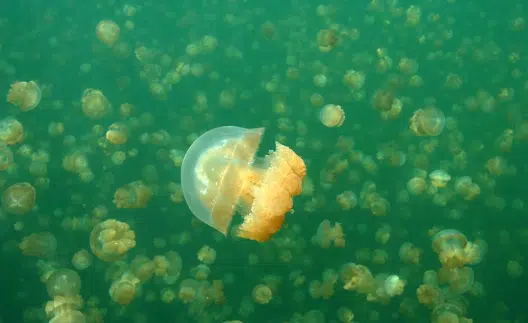
In the Rock Islands of Palau, a unique marine lake called Jellyfish Lake is home to a population of jellyfish that has evolved in isolation for around 12,000 years. Located on the uninhabited island of Eil Malk, this lake is notable for having a distinct subspecies of jellyfish that is found nowhere else on Earth.
Cut off from the ocean since the last ice age, Jellyfish Lake has developed into a closed ecosystem where life has evolved independently. It is around 400 meters long and 30 meters deep, surrounded by mangrove trees that support various marine invertebrates. Over time, jellyfish have become the dominant creatures in this environment.
The primary species residing in the lake is the golden jellyfish (Mastigias papua etpisoni), named after a former president of Palau, Ngiratkel Etpison. After thousands of years without outside contact, these jellyfish have developed unique traits. They migrate daily in response to the Sun, moving towards the east at sunrise and shifting westward as the day progresses. This synchronized movement creates visual effects that appear as a wall of jellyfish.
Their migration is closely linked to their relationship with dinoflagellates, tiny algae that live within the jellyfish. These algae require sunlight to produce energy, and in return, they provide nutrients to the jellyfish.
Jellyfish Lake typically holds around 5 million golden jellyfish, but this number has changed over time. In 2005, the population peaked at around 30 million, but a sharp decline occurred by 2016, prompting a temporary closure of the lake for two years. Researchers connected this decline to the effects of El Niño, which raised water temperatures and disrupted algae growth. By 2019, jellyfish numbers recovered, allowing visitors to return to this extraordinary natural site.


