Warning: foreach() argument must be of type array|object, false given in /home/u750883576/domains/esl-news.com/public_html/wp-content/plugins/gpt-post-quiz/includes/admin/class-gpoq-admin-4.php on line 450
Warning: foreach() argument must be of type array|object, false given in /home/u750883576/domains/esl-news.com/public_html/wp-content/plugins/td-composer/legacy/common/wp_booster/td_menu.php on line 88
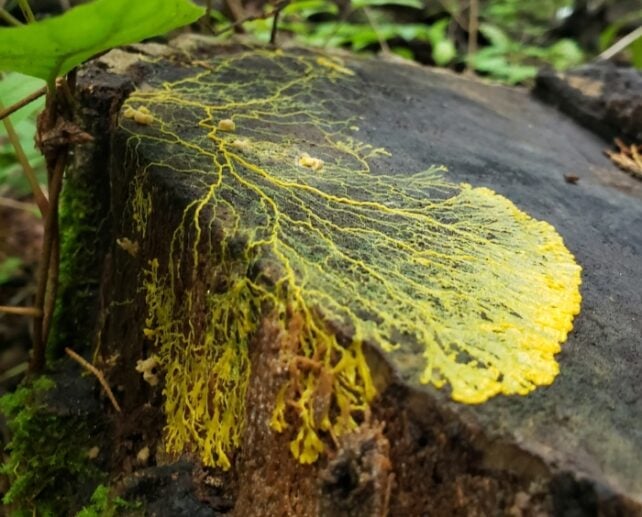
Slime molds are interesting creatures. They are not true molds or fungi. For most of their lives, they exist as shapes called plasmodia or amoebae, and they do not follow the rules that other life forms must follow.
Slime molds are famous because they can act in ways that look smart, even though they do not have brains or nervous systems. A recent study has looked into how they move together as a group. The most well-known slime mold is called Physarum polycephalum, which means "the small bubble with many heads." This slime mold can crawl around to find food if it runs out.
Scientists in Germany and the United States found that slime molds can "decide" where to go, even if they do not make decisions like animals do. They escape traps made of blue light when searching for food. Under this light, the slime mold puffs up and then escapes.
The study showed that the mold expands its body in certain ways to create pressure, helping it move. The research helps us understand how non-neuronal systems, or those without brains, adapt their behaviour to survive.
Test Your Understanding
Start Quiz
How much do you know?
What shapes do slime molds exist as for most of their lives?
Fungi
Plasmodia or amoebae
True molds
Cells
What is the scientific name of the most well-known slime mold?
Amoeba proteus
Physarum polycephalum
Rhizopus stolonifer
Sordaria fimicola
Which country conducted research alongside scientists from the United States?
Canada
France
Germany
Japan
How do slime molds react to blue light when searching for food?
They are attracted to it
They puff up and escape
They freeze in place
They multiply
What do slime molds lack that distinguishes them from animals?
Nervous systems
Proteins
Cells
DNA
What does the behavior of slime molds help scientists understand?
Cognitive evolution
Ecosystem dynamics
Non-neuronal systems
Genetic mutation
Slime molds are classified as true fungi.
Slime molds can make decisions like animals do.
The study mentioned is focused on how slime molds move as individuals.
Physarum polycephalum translates to 'the small bubble with many heads.'
Slime molds have brains similar to those of animals.
Slime molds can create pressure to help them move.
Slime molds are not true molds or .
The most famous slime mold is called polycephalum.
Slime molds can escape traps made of blue light when searching for .
The study on slime molds helps in understanding non-neuronal .
Slime molds exist as shapes called plasmodia or .
Researchers found that slime molds can decide where to go even without a .