

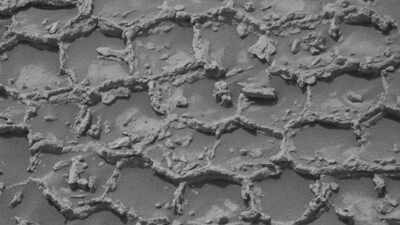
NASA’s Curiosity rover has made a fascinating discovery on Mars, revealing a mysterious honeycomb-like pattern on the planet’s surface. This finding adds to the numerous geological features that continue to intrigue scientists researching Mars. The rover, which landed in 2012, photographed this unusual texture during its exploration in Gale Crater.
The formation consists of polygonal structures that resemble a giant honeycomb, leaving scientists unsure about their origin. The team was surprised to find these features and noted that they looked different when viewed from the ground compared to images taken from orbit. They discovered that the surface was littered with dark rocks ranging in size from pebbles to larger cobbles.
Researchers are exploring whether these rocks originated from higher layers of the Martian surface, were ejected from impacts, or are meteorites from beyond Mars. Despite Earth having similar patterns formed by drying mud or crystallising materials, it remains uncertain whether these structures on Mars formed through similar processes.
The layered terrain also piques interest, as scientists plan to conduct further analyses of the dark rocks, named “Cortadera.” These rocks might have unique mineral content, akin to findings from earlier rover missions. As the Curiosity rover continues its mission, it will soon approach areas of darker and rougher materials.
This ongoing exploration signifies that Mars still has many secrets to unveil, with scientists eager to understand the potential connection between the honeycomb formations and the surrounding geological features.
Test Your Understanding
How much do you know?