

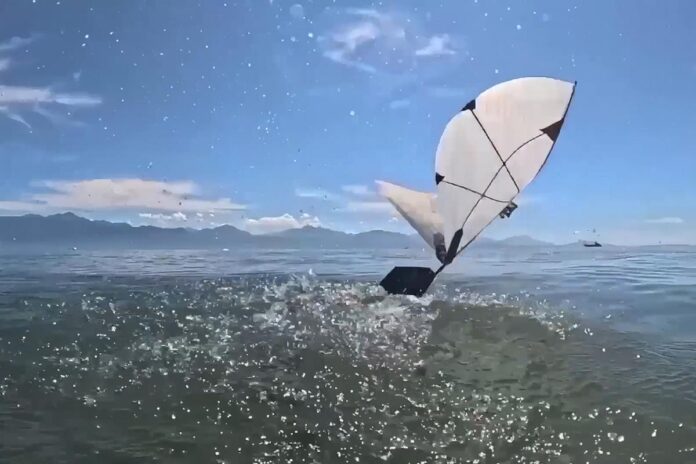
Engineers at the Massachusetts Institute of Technology (MIT) have developed a groundbreaking flying robot that can also dive underwater. Inspired by birds such as puffins, this innovative device could assist scientists in exploring difficult-to-reach underwater environments.
The concept of creating a robot that mimics a diving bird posed significant challenges and required two years of research. Raphael Zufferey, the project leader, initially viewed the task as daunting but, along with his team, embarked on a systematic study of various birds capable of both flying and swimming. Through a series of small-scale experiments, they gradually engineered their unique flying-swimming robot.
A major hurdle the engineers faced was the density of water compared to air. Many birds retract their wings when submerged, but the team aimed for their robot’s wings to function effectively in both elements. They experimented with various wing sizes, ultimately determining that a span of approximately 34.5 inches (88 centimeters) offered optimal performance. The wings consist of a durable, lightweight fabric stretched across robust, flexible supports.
In flight, the robot’s wings flap five to six times per second, enabling it to soar through the air, while in the water, they facilitate swimming. The robot is also equipped with a motorized tail that aids in adjusting its orientation.
The device weighs slightly over half a pound (250 grams) and is designed to maintain a balanced position in water, neither sinking nor floating. To minimise weight, the researchers opted against an outer covering, instead waterproofing internal components.
While inspired by nature, the engineers streamlined the design by omitting legs, which added unnecessary complexity. Instead, the robot relies on its wings for propulsion when exiting the water, requiring a rapid increase in flapping frequency to about ten times per second.
Testing occurred in a large water tank at MIT as well as in Lake Geneva, Switzerland. Footage captured the robot’s impressive ability to break through the water surface and ascend in less than a second.
The implications of this technology excite the researchers, who envision its potential in monitoring coral reefs, tracking fish populations, or examining harmful algal blooms. Zufferey envisages a future where scientists could transport the robot in a backpack, deploy it to remote areas, and retrieve valuable data.
Currently, the robot can fly approximately 3.75 miles (6 kilometres) on a full charge and swim roughly 1.25 miles (2 kilometres) underwater. Researchers aim to enhance these capabilities to extend its operational range.


