Wednesday, April 29, 2026

Fossils of Prehistoric Dagger-Toothed Sea Monster Discovered in Morocco

A newly found fossil of a marine lizard with sharp teeth is providing scientists with valuable insights into life at the end of the dinosaur era. Named Khinjaria acuta, this fierce predator lived in the waters off modern-day Morocco around 66 million years ago. Its remains reveal a diverse ocean filled with large hunters, vastly different from today’s seas.

The study describes Khinjaria acuta as belonging to the Mosasauridae family, which includes large marine lizards related to Komodo dragons and snakes. These reptiles thrived in the Late Cretaceous period while dinosaurs like Tyrannosaurus and Triceratops roamed the land.

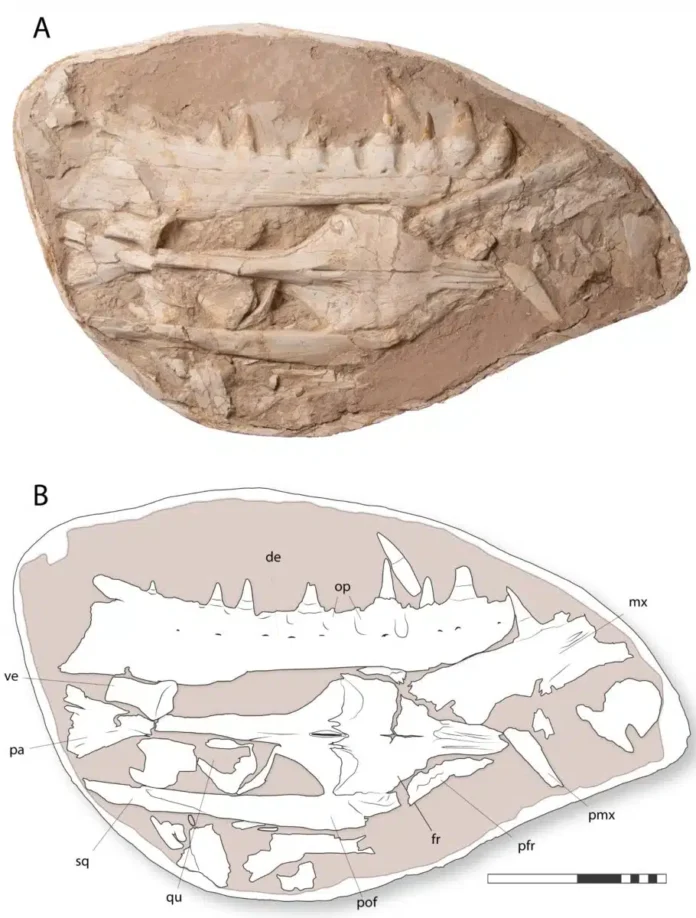
The recovered fossil, including a skull and parts of the skeleton, was found in a phosphate mine southeast of Casablanca. Researchers from various institutions collaborated on this study, including the University of Bath and the Marrakech Museum of Natural History.

The skull of Khinjaria acuta is notable for its powerful snout and long, dagger-like teeth, ideal for grabbing prey. Unlike other mosasaurs known in the area, which had teeth for crushing or slicing, Khinjaria had teeth specialised for piercing, revealing new details about these ancient predators.

This discovery highlights the rich ecosystem of the Late Cretaceous era, which included multiple species of giant predators, as stated by Dr. Nick Longrich from the University of Bath. Interestingly, modern oceans host far fewer apex predators than those observed in the past. The fossil evidence also sheds light on the unique marine environment that supported such biodiversity in Morocco.

Test Your Understanding

Start Quiz

Vocabulary List:
6 words · tap to reveal
ON

Accent

Fossil/ˈfɑː.səl/noun
The preserved remains or traces of a once-living organism often found in sedimentary rock.

Ecosystem/ˈiː.koʊˌsɪs.təm/noun
A biological community of interacting organisms and their physical environment.

Thrive/θraɪv/verb
To grow or develop successfully; to flourish.

Specialised/ˈspeʃ.əl.aɪzd/adjective
Designed or trained for a particular purpose or area of activity.

Predator/ˈprɛd.ɪ.tər/noun
An animal that hunts and kills other animals for food.

Biodiversity/ˌbaɪ.oʊ.dɪˈvɜr.sɪ.ti/noun
The variety of plant and animal life in a particular habitat often considered a measure of the health of an ecosystem.

How much do you know?

What is the name of the newly found marine lizard fossil?
Khinjaria acuta
Mosasaurus
Tyrannosaurus
Triceratops
How many million years ago did Khinjaria acuta live?
150
66
75
100
Which family does Khinjaria acuta belong to?
Dinosauria
Mosasauridae
Reptilia
Cretaceous
Where was the fossil of Khinjaria acuta found?
Casablanca
Marrakech
Fes
Tangier
What kind of teeth did Khinjaria acuta possess?
Flat teeth
Dagger-like teeth
Crushing teeth
Cylindrical teeth
Which institution is NOT mentioned as part of the research team?
University of Bath
Marrakech Museum of Natural History
Harvard University
Yale University
Khinjaria acuta was discovered in Morocco.
The fossil includes only a skull.
Khinjaria acuta had teeth designed for slicing.
Dr. Nick Longrich is associated with the University of Bath.
Modern oceans have more apex predators than those in the past.
The marine environment 66 million years ago was less diverse than today.
The fossil of Khinjaria acuta was found in a phosphate mine .
Khinjaria acuta lived in the waters off modern-day Morocco.
Khinjaria acuta is related to dragons and snakes.
The skull of Khinjaria acuta has a powerful snout and long, teeth.
The Late Cretaceous era included multiple species of predators.
The fossil evidence indicates a marine environment in Morocco.
This question is required

Test Your Understanding

Start Quiz
Vocabulary List:
6 words · tap to reveal
ON
Accent
Fossil/ˈfɑː.səl/noun
The preserved remains or traces of a once-living organism often found in sedimentary rock.
Ecosystem/ˈiː.koʊˌsɪs.təm/noun
A biological community of interacting organisms and their physical environment.
Thrive/θraɪv/verb
To grow or develop successfully; to flourish.
Specialised/ˈspeʃ.əl.aɪzd/adjective
Designed or trained for a particular purpose or area of activity.
Predator/ˈprɛd.ɪ.tər/noun
An animal that hunts and kills other animals for food.
Biodiversity/ˌbaɪ.oʊ.dɪˈvɜr.sɪ.ti/noun
The variety of plant and animal life in a particular habitat often considered a measure of the health of an ecosystem.

How much do you know?

What is the name of the newly found marine lizard fossil?
Khinjaria acuta
Mosasaurus
Tyrannosaurus
Triceratops
How many million years ago did Khinjaria acuta live?
150
66
75
100
Which family does Khinjaria acuta belong to?
Dinosauria
Mosasauridae
Reptilia
Cretaceous
Where was the fossil of Khinjaria acuta found?
Casablanca
Marrakech
Fes
Tangier
What kind of teeth did Khinjaria acuta possess?
Flat teeth
Dagger-like teeth
Crushing teeth
Cylindrical teeth
Which institution is NOT mentioned as part of the research team?
University of Bath
Marrakech Museum of Natural History
Harvard University
Yale University
Khinjaria acuta was discovered in Morocco.
The fossil includes only a skull.
Khinjaria acuta had teeth designed for slicing.
Dr. Nick Longrich is associated with the University of Bath.
Modern oceans have more apex predators than those in the past.
The marine environment 66 million years ago was less diverse than today.
The fossil of Khinjaria acuta was found in a phosphate mine .
Khinjaria acuta lived in the waters off modern-day Morocco.
Khinjaria acuta is related to dragons and snakes.
The skull of Khinjaria acuta has a powerful snout and long, teeth.
The Late Cretaceous era included multiple species of predators.
The fossil evidence indicates a marine environment in Morocco.
This question is required

Read More