Warning: foreach() argument must be of type array|object, false given in /home/u750883576/domains/esl-news.com/public_html/wp-content/plugins/gpt-post-quiz/includes/admin/class-gpoq-admin-4.php on line 450
Warning: foreach() argument must be of type array|object, false given in /home/u750883576/domains/esl-news.com/public_html/wp-content/plugins/td-composer/legacy/common/wp_booster/td_menu.php on line 88
A chance discussion with neuroscientist Kale Scatterty led to a new study on how humans respond to infrasound. In 2023, Scatterty’s research showed that zebrafish displayed anxiety and avoided certain areas when exposed to infrasound. This suggested a physical reaction to infrasound, prompting researcher Schmaltz to investigate if humans might react similarly. They designed an experiment to test if infrasound would increase cortisol levels in human saliva, a common stress indicator.
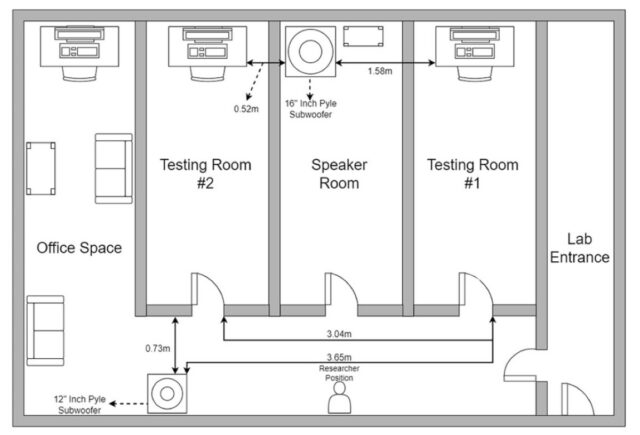
Thirty-six participants were placed alone in a room and exposed to either calming music or unsettling ambient sounds. Some were also exposed to infrasound from hidden subwoofers. Schmaltz expected that infrasound would enhance the relaxing effect of calming music and increase the fear from scarier music.
Instead, all participants felt more irritated and unsettled when the infrasound was on, regardless of the music type, and their cortisol levels rose significantly. Notably, none could accurately detect the presence of infrasound, suggesting humans can experience a physiological response to infrasound unconsciously.
Although these findings are promising, Schmaltz notes that infrasound alone doesn’t explain perceptions of hauntings. Other factors, such as suggestibility, also play a role. Schmaltz clarifies, “Infrasound isn’t causing hauntings. It might contribute, especially in old buildings with rumbling pipes. If someone already expects something spooky, infrasound might enhance that expectation. It’s part of the puzzle rather than a complete explanation.”