Warning: foreach() argument must be of type array|object, false given in /home/u750883576/domains/esl-news.com/public_html/wp-content/plugins/gpt-post-quiz/includes/admin/class-gpoq-admin-4.php on line 450
Warning: foreach() argument must be of type array|object, false given in /home/u750883576/domains/esl-news.com/public_html/wp-content/plugins/td-composer/legacy/common/wp_booster/td_menu.php on line 88
Crater-Earth-Concept-777x518.jpg?ssl=1&w=75&resize=75&ssl=1 75w, https://i2.wp.com/scitechdaily.com/images/Giant-Crater-Earth-Concept-777x518.jpg?ssl=1&w=100&resize=100&ssl=1 100w, https://i2.wp.com/scitechdaily.com/images/Giant-Crater-Earth-Concept-777x518.jpg?ssl=1&w=150&resize=150&ssl=1 150w, https://i2.wp.com/scitechdaily.com/images/Giant-Crater-Earth-Concept-777x518.jpg?ssl=1&w=240&resize=240&ssl=1 240w, https://i2.wp.com/scitechdaily.com/images/Giant-Crater-Earth-Concept-777x518.jpg?ssl=1&w=320&resize=320&ssl=1 320w, https://i2.wp.com/scitechdaily.com/images/Giant-Crater-Earth-Concept-777x518.jpg?ssl=1&w=500&resize=500&ssl=1 500w, https://i2.wp.com/scitechdaily.com/images/Giant-Crater-Earth-Concept-777x518.jpg?ssl=1&w=640&resize=640&ssl=1 640w, https://i2.wp.com/scitechdaily.com/images/Giant-Crater-Earth-Concept-777x518.jpg?ssl=1&w=800&resize=800&ssl=1 800w, https://i2.wp.com/scitechdaily.com/images/Giant-Crater-Earth-Concept-777x518.jpg?ssl=1&w=1024&resize=1024&ssl=1 1024w, https://i2.wp.com/scitechdaily.com/images/Giant-Crater-Earth-Concept-777x518.jpg?ssl=1&w=1280&resize=1280&ssl=1 1280w, https://i2.wp.com/scitechdaily.com/images/Giant-Crater-Earth-Concept-777x518.jpg?ssl=1&w=1600&resize=1600&ssl=1 1600w" fetchpriority="high" decoding="async" class="wp-image-416213 size-large" fifu-data-src="https://i2.wp.com/scitechdaily.com/images/Giant-Crater-Earth-Concept-777x518.jpg?ssl=1" alt="Giant Crater Earth Concept" width="777" height="518" srcset="https://i2.wp.com/scitechdaily.com/images/Giant-Crater-Earth-Concept-777x518.jpg?ssl=1 777w, https://scitechdaily.com/images/Giant-Crater-Earth-Concept-400x267.jpg 400w, https://scitechdaily.com/images/Giant-Crater-Earth-Concept-768x512.jpg 768w, https://scitechdaily.com/images/Giant-Crater-Earth-Concept-1536x1024.jpg 1536w, https://scitechdaily.com/images/Giant-Crater-Earth-Concept-150x100.jpg 150w, https://scitechdaily.com/images/Giant-Crater-Earth-Concept-450x300.jpg 450w, https://scitechdaily.com/images/Giant-Crater-Earth-Concept-1200x800.jpg 1200w, https://scitechdaily.com/images/Giant-Crater-Earth-Concept.jpg 2000w" sizes="(max-width: 777px) 100vw, 777px"/>A colossal crater extending over 370 miles (600 kilometers) in central Australia, referred to as MAPCIS, stands poised to revolutionize our comprehension of the Earth’s geological past. Scientists have unearthed geological clues indicating a monumental impact marking the conclusion of the Ediacaran period. (Illustration) Credit: SciTechDaily.com
An Inquiry into Ancient History: Unveiling Centuries-Old Enigmas
A giant crater measuring over 370 miles (600 kilometers) across in central Australia has the potential to alter our understanding of the Earth’s geological narrative.
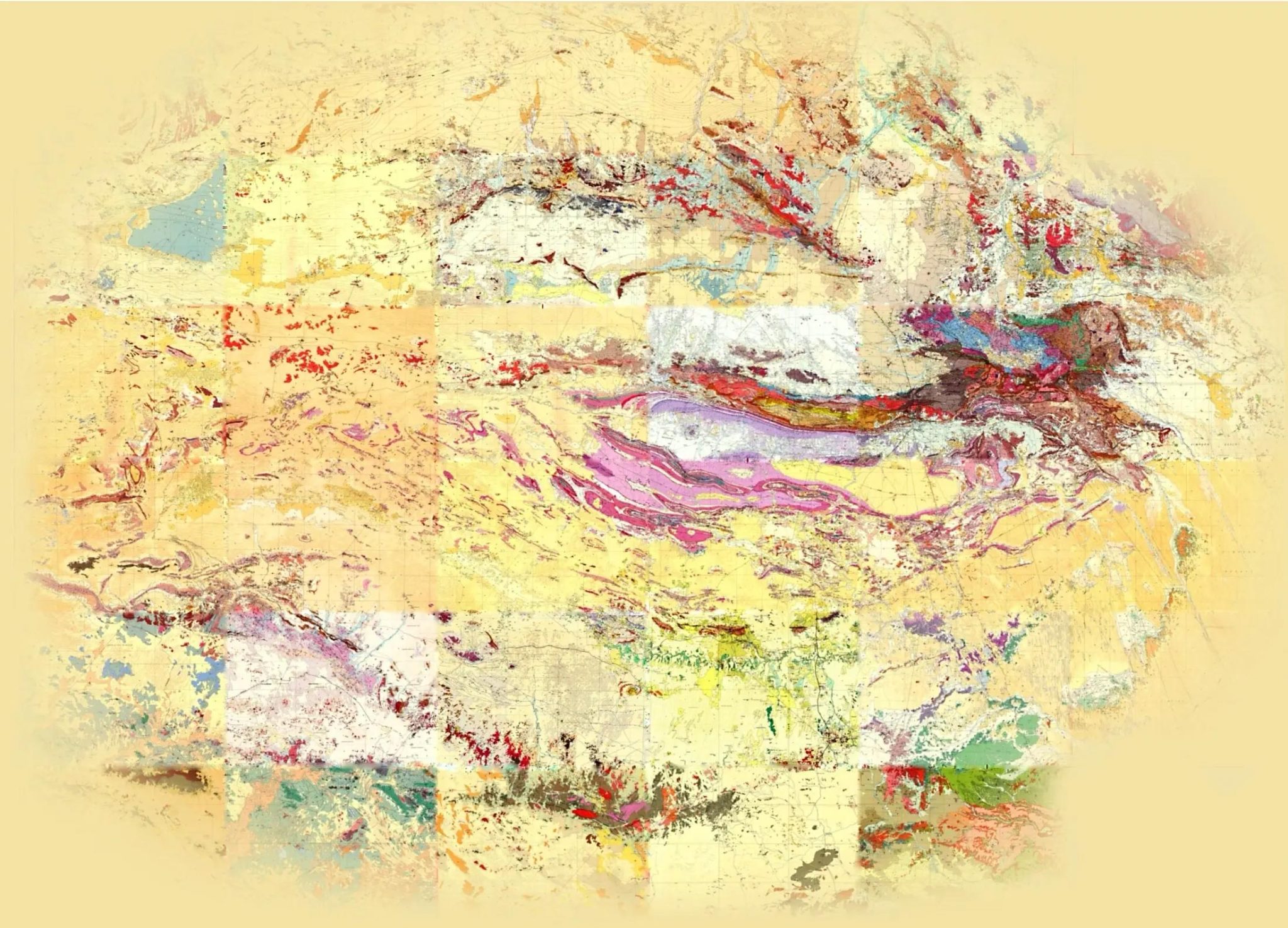
Daniel Connelly and Arif Sikder, Ph.D., from Virginia Commonwealth University, are investigating the existence of MAPCIS – the Massive Australian Precambrian-Cambrian Impact Structure – a multi-ringed complex crater that presents an opportunity to gain fresh perspectives on the geological and biological evolution of our planet.
“Engaging in the MAPCIS project has been an extraordinary odyssey,” remarked Sikder, an associate professor in the Center for Environmental Studies, a division of VCU Life Sciences. “The data we’ve amassed provides a distinctive glimpse into the forces that have sculpted our world, and I anticipate the forthcoming research inspired by this discovery.”
An illustrative geological map showcasing the proposed Massive Australian Precambrian-Cambrian Impact Structure. Credit: Daniel Connelly
This September, Connelly is set to deliver a presentation in Anaheim, California, at Connects 2024, the Geological Society of America’s annual gathering. In August, he shared insights at the 37th International Geological Congress 2024 in Busan, South Korea. According to researchers, the impact event unfolded at the conclusion of the Ediacaran period, within the Neoproterozoic Era, spanning from 1 billion to 538.8 million years ago.
Geological Remnants of the Catastrophe
Supporting the age, size, and location of the impact, the researchers have unearthed substantial deposits of pseudotachylite breccia, or fused rock, near the heart of the crater. Among the findings are shocked minerals, including lonsdaleite, a form of shocked diamond, within the deposits, alongside elevated levels of iridium attributable to the impact.
“The revelation of MAPCIS underscores the potency of collaborative research,” noted Connelly. “Our discoveries not only underscore the importance of this impact structure but also pave the way for a deeper comprehension of the Earth’s geological legacy.”
Conference: Connects 2024
Test Your Understanding
Start Quiz
Vocabulary List:
6 words · tap to reveal
ON
Accent
Crater/ˈkreɪ.tər/noun
A large bowl-shaped cavity in the ground often caused by an explosion or impact.
Geological/ˌdʒiː.əˈlɒdʒ.ɪ.kəl/adjective
Relating to the study of the earth its structure and processes.
Monumental/ˌmɒn.jʊˈmen.təl/adjective
Of great significance or size.
Pseudotachylite/ˌsuː.dəʊ.tɑː.kɪˈlaɪt/noun
A type of rock formed by the melting of surrounding materials typically due to a high-velocity impact.
Iridium/ɪˈrɪ.di.əm/noun
A dense silvery-white metallic element often used in alloys and known to be rare on earth.