Tuesday, March 31, 2026

Astronomers Measure Universe’s Most Violent Wind for First Time

For the first time, scientists have measured the incredible speed of hot gas erupting from the heart of M82, a galaxy that forms stars at a rate ten times faster than the Milky Way. This gas is moving at speeds exceeding 3 million kilometres per hour, capable of creating a massive outflow that extends tens of thousands of light-years into space.

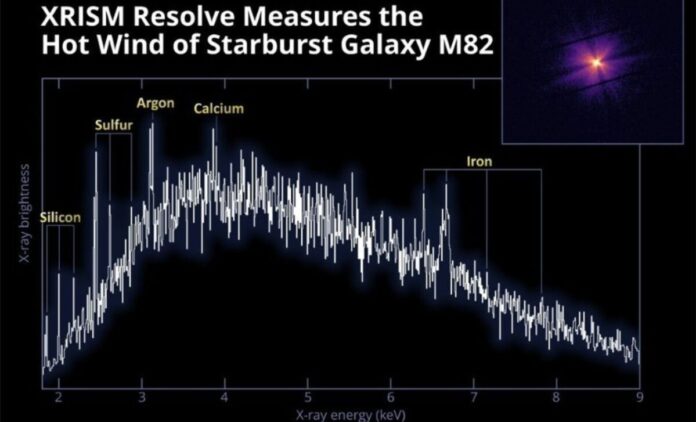
This significant discovery arose from the XRISM spacecraft, a joint project by JAXA and NASA. The highly sensitive Resolve instrument onboard detected X-ray emissions from superheated iron in M82’s core. These findings, published in Nature on March 25, address a question that has puzzled astronomers for decades: what drives the dramatic outflow seen from this nearby galaxy?

Starburst galaxies, like M82, are intriguing to researchers due to their intense activity. They consume gas reserves rapidly, creating powerful winds and enormous outflows. Understanding these phenomena is essential for grasping how galaxies evolve and how star formation operates within them.

The researchers measured the wind speed by observing how light changes when it’s moving towards or away from them, known as the Doppler effect. The high-speed iron found was found to be ejecting in multiple directions, providing data that indicated an impressive wind velocity. The temperature of the gas matched predictions, reaching around 25 million degrees Celsius.

While previous theories suggested that shockwaves from supernovae and intense star formation heated surrounding gas, XRISM has confirmed that the outflow is strong enough to expel four solar masses of gas from the galaxy each year. However, it remains unclear what happens to an additional three solar masses, creating a mystery that future studies will aim to resolve.

Test Your Understanding

Start Quiz

Vocabulary List:
6 words · tap to reveal
ON

AccentSpeed

outflow/ˈaʊtfloʊ/noun
a large movement of gas moving outward

erupting/ɪˈrʌptɪŋ/verb
bursting out suddenly and with great force

emissions/ɪˈmɪʃənz/noun
substances or energy sent out from something

superheated/ˌsuːpərˈhiːtɪd/adjective
heated to a much higher temperature than normal

velocity/vəˈlɑsəti/noun
how fast something moves in a direction

expel/ɪkˈspɛl/verb
to force something out from a place

How much do you know?

What galaxy is discussed in the text?
Andromeda
Milky Way
M82
Whirlpool Galaxy
What is the speed of the hot gas erupting from M82?
1 million kilometres per hour
2 million kilometres per hour
3 million kilometres per hour
4 million kilometres per hour
Which spacecraft was involved in the discovery?
Hubble Space Telescope
Chandra X-ray Observatory
XRISM spacecraft
James Webb Space Telescope
Which instrument onboard XRISM detected X-ray emissions?
Resolve
Spectrometer
Imager
Analyzer
On what date were the findings published?
March 25
April 1
February 15
January 10
How many solar masses of gas does the outflow expel from the galaxy each year?
Three
Four
Five
Six
M82 forms stars at a rate ten times slower than the Milky Way.
The temperature of the gas in M82 is around 25 million degrees Celsius.
The Doppler effect is used to measure the wind speed.
XRISM is a project solely by NASA.
Previous theories suggested that supernovae shockwaves may influence surrounding gas.
M82 is not a starburst galaxy.
The gas in M82 is moving at speeds exceeding million kilometres per hour.
The significant discovery was made using the XRISM spacecraft.
X-ray emissions were detected from superheated in M82’s core.
The researchers believe that the outflow can expel solar masses of gas from the galaxy each year.
The temperature of the gas reaches around million degrees Celsius.
Understanding the outflow helps grasp how galaxies and how star formation operates.
This question is required

Test Your Understanding

Start Quiz
Vocabulary List:
6 words · tap to reveal
ON
AccentSpeed
outflow/ˈaʊtfloʊ/noun
a large movement of gas moving outward
erupting/ɪˈrʌptɪŋ/verb
bursting out suddenly and with great force
emissions/ɪˈmɪʃənz/noun
substances or energy sent out from something
superheated/ˌsuːpərˈhiːtɪd/adjective
heated to a much higher temperature than normal
velocity/vəˈlɑsəti/noun
how fast something moves in a direction
expel/ɪkˈspɛl/verb
to force something out from a place

How much do you know?

What galaxy is discussed in the text?
Andromeda
Milky Way
M82
Whirlpool Galaxy
What is the speed of the hot gas erupting from M82?
1 million kilometres per hour
2 million kilometres per hour
3 million kilometres per hour
4 million kilometres per hour
Which spacecraft was involved in the discovery?
Hubble Space Telescope
Chandra X-ray Observatory
XRISM spacecraft
James Webb Space Telescope
Which instrument onboard XRISM detected X-ray emissions?
Resolve
Spectrometer
Imager
Analyzer
On what date were the findings published?
March 25
April 1
February 15
January 10
How many solar masses of gas does the outflow expel from the galaxy each year?
Three
Four
Five
Six
M82 forms stars at a rate ten times slower than the Milky Way.
The temperature of the gas in M82 is around 25 million degrees Celsius.
The Doppler effect is used to measure the wind speed.
XRISM is a project solely by NASA.
Previous theories suggested that supernovae shockwaves may influence surrounding gas.
M82 is not a starburst galaxy.
The gas in M82 is moving at speeds exceeding million kilometres per hour.
The significant discovery was made using the XRISM spacecraft.
X-ray emissions were detected from superheated in M82’s core.
The researchers believe that the outflow can expel solar masses of gas from the galaxy each year.
The temperature of the gas reaches around million degrees Celsius.
Understanding the outflow helps grasp how galaxies and how star formation operates.
This question is required

Read More