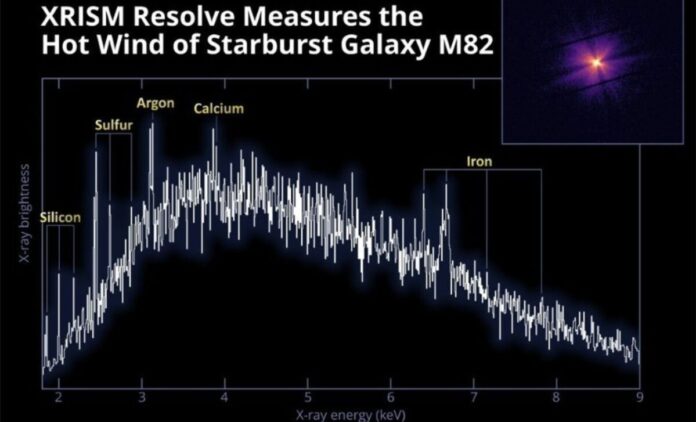
Scientists have for the first time measured the speed of hot gas erupting from the heart of the galaxy M82, which produces stars ten times faster than the Milky Way. This gas, moving over 3 million kilometres per hour, could drive a massive outflow of material stretching tens of thousands of light-years into space.
This discovery comes from the XRISM spacecraft, a collaboration between JAXA and NASA. Using its sensitive Resolve instrument, researchers captured X-ray emissions from superheated iron at the core of M82. The research, published on 25 March in Nature, addresses a long-standing question: what drives the powerful outflow observed in this galaxy?
M82 is a starburst galaxy, meaning it consumes gas rapidly, leading to extreme phenomena such as violent winds and colossal outflows. These processes are crucial for understanding galaxy evolution and star formation.
The measurement relied on the Doppler effect, where the movement of light sources shifts its spectrum. At M82’s centre, outwards-moving iron broadens its spectral lines, revealing a wind velocity exceeding 2 million miles per hour. The gas temperature was found to be about 45 million degrees Fahrenheit (25 million degrees Celsius), generating substantial outward pressure that pushes gas into lower-pressure regions.
The data aligns with theories that shockwaves from supernovae heat surrounding gas, starting large-scale winds. The results confirm that the hot inner wind is strong enough to expel four solar masses of gas from the galaxy annually, but three solar masses remain unexplained. This opens new questions for future research on whether this gas escapes M82 or recycles back into it.
Test Your Understanding
How much do you know?