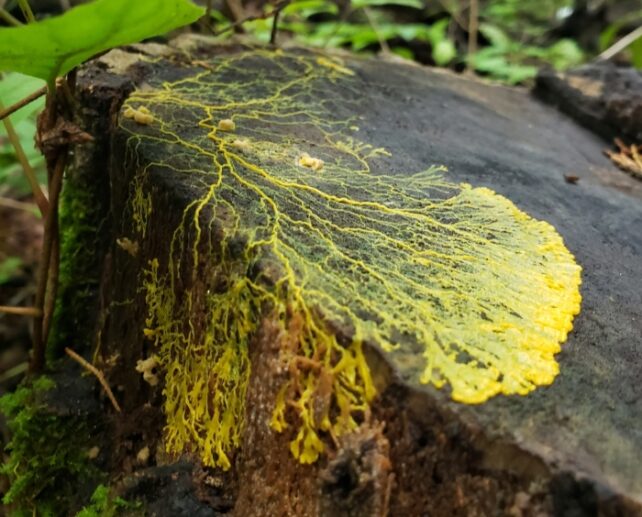
Slime molds, which aren’t actual molds or fungi, have intrigued scientists by showing seemingly intelligent behaviour without a brain or nervous system. Found as either plasmodia or amoebae, these organisms can adapt beyond traditional life forms’ limitations.
A new study has explored how slime molds, specifically the yellow Physarum polycephalum, coordinate their movements. Known for solving mazes in search of food, these molds can ‘decide’ on actions among options, despite lacking a central decision-making system like a brain.
Researchers from Germany and the US have gained insights into this decentralized decision-making. Physarum polycephalum, which avoids blue light, can be ‘trapped’ with light barriers of 470 nm. However, when starved, it attempts to break through these barriers using protrusions.
The study found that these protrusions allow the slime mold to escape, appearing to bubble and pulse before moving beyond the confines. The mold’s rhythmic contractions, similar to muscle movements, redistribute its mass and help it adapt to its surroundings.
During experiments, scientists placed slime molds in light-free areas surrounded by geometrically patterned blue light barriers. As hunger drove them, the molds extended their network until finding ways to escape.
Researchers observed that these molds often escape along the longest axis of the shape, suggesting the path selection is driven by mechanical processes rather than conscious decisions. This study sheds light on how non-neuronal organisms adapt by using fluid flows, expanding understanding of decentralized systems.
The findings are published in the journal PRX Life.
Test Your Understanding
How much do you know?