Tuesday, March 31, 2026

First Measurement of Universe’s Most Violent Wind

Scientists have measured the speed of hot gas from M82, a galaxy that forms stars much faster than the Milky Way. The gas moves at over 3 million kilometres per hour, which could push gas into space and create an outflow stretching thousands of light-years.

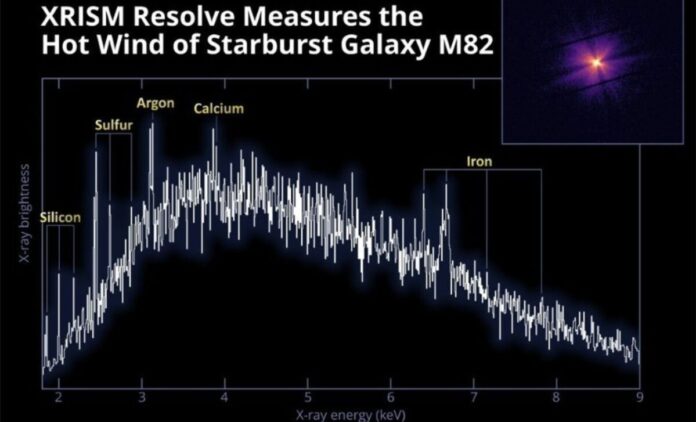
This discovery comes from the XRISM spacecraft, a mission by JAXA and NASA. Its sensitive instrument detected X-ray emissions from heated iron at M82’s centre. The findings, published in Nature, help answer a long-standing question about what drives the outflow visible from this galaxy.

M82 and similar galaxies are interesting to scientists because they burn through their gas rapidly. This creates strong winds and massive gas flows that change the galaxy and its surroundings. Understanding these winds is important for learning how galaxies evolve and how stars are formed.

The researchers used the Doppler effect, which is the change in sound pitch when a source moves. They found that iron is moving outward in many directions, revealing a wind velocity over 3 million kilometres per hour. The gas temperature was about 25 million degrees Celsius, creating strong outward pressure.

While the new data supports previous theories about shockwaves causing winds, it also raises questions. M82 seems to release enough material to form seven solar masses of stars each year, but four of those are unaccounted for. Scientists must now find where these missing masses go.


Test Your Understanding

Start Quiz

Vocabulary List:
6 words · tap to reveal
ON

AccentSpeed

outflow/ˈaʊtfloʊ/noun
movement of gas or liquid away from something

emissions/ɪˈmɪʃənz/noun
gases or energy sent out from something

velocity/vəˈlɑsəti/noun
how fast something moves in a direction

pressure/ˈprɛʃər/noun
a force that pushes on something

shockwaves/ˈʃɑkweɪvz/noun
strong waves of energy through air or matter

unaccounted/ˌʌnəˈkaʊntɪd/adjective
not explained or not shown in records

How much do you know?

What is the speed of hot gas from M82?
1 million kilometres per hour
2 million kilometres per hour
3 million kilometres per hour
4 million kilometres per hour
Which two space agencies are involved in the XRISM spacecraft mission?
NASA and ESA
NASA and JAXA
JAXA and ESA
NASA and Roscosmos
In which journal were the findings about M82 published?
Science
Nature
Astrophysical Journal
Monthly Notices of the Royal Astronomical Society
What temperature was the gas at M82 approximately?
15 million degrees Celsius
20 million degrees Celsius
25 million degrees Celsius
30 million degrees Celsius
How many solar masses of stars does M82 seem to release each year?
Five
Six
Seven
Eight
What phenomenon did the researchers use to study the movement of iron in M82?
Redshift
Blue shift
Doppler effect
Gravitational lensing
The gas from M82 moves slower than the speed of sound.
The heated iron emissions were detected at the center of M82.
M82 releases exactly seven solar masses of stars each year.
Understanding the winds from M82 is unimportant for understanding galaxy evolution.
The gas temperature at M82 is about 25 million degrees Celsius.
Shockwaves causing winds are a new theory regarding M82.
The gas from M82 moves at over kilometres per hour.
The mission by JAXA and NASA is called .
The findings about M82 help answer questions about what drives visible from this galaxy.
The temperature of the gas was about million degrees Celsius.
M82 seems to release enough material to form seven solar of stars each year.
Scientists are trying to find where the masses go in M82.
This question is required

Test Your Understanding

Start Quiz
Vocabulary List:
6 words · tap to reveal
ON
AccentSpeed
outflow/ˈaʊtfloʊ/noun
movement of gas or liquid away from something
emissions/ɪˈmɪʃənz/noun
gases or energy sent out from something
velocity/vəˈlɑsəti/noun
how fast something moves in a direction
pressure/ˈprɛʃər/noun
a force that pushes on something
shockwaves/ˈʃɑkweɪvz/noun
strong waves of energy through air or matter
unaccounted/ˌʌnəˈkaʊntɪd/adjective
not explained or not shown in records

How much do you know?

What is the speed of hot gas from M82?
1 million kilometres per hour
2 million kilometres per hour
3 million kilometres per hour
4 million kilometres per hour
Which two space agencies are involved in the XRISM spacecraft mission?
NASA and ESA
NASA and JAXA
JAXA and ESA
NASA and Roscosmos
In which journal were the findings about M82 published?
Science
Nature
Astrophysical Journal
Monthly Notices of the Royal Astronomical Society
What temperature was the gas at M82 approximately?
15 million degrees Celsius
20 million degrees Celsius
25 million degrees Celsius
30 million degrees Celsius
How many solar masses of stars does M82 seem to release each year?
Five
Six
Seven
Eight
What phenomenon did the researchers use to study the movement of iron in M82?
Redshift
Blue shift
Doppler effect
Gravitational lensing
The gas from M82 moves slower than the speed of sound.
The heated iron emissions were detected at the center of M82.
M82 releases exactly seven solar masses of stars each year.
Understanding the winds from M82 is unimportant for understanding galaxy evolution.
The gas temperature at M82 is about 25 million degrees Celsius.
Shockwaves causing winds are a new theory regarding M82.
The gas from M82 moves at over kilometres per hour.
The mission by JAXA and NASA is called .
The findings about M82 help answer questions about what drives visible from this galaxy.
The temperature of the gas was about million degrees Celsius.
M82 seems to release enough material to form seven solar of stars each year.
Scientists are trying to find where the masses go in M82.
This question is required

Read More