Monday, May 4, 2026

Interest on US Debt Fuelling Future Deficits

U.S. national debt is forecasted to rise significantly in the coming decades, driven not just by possible future government decisions but mainly due to escalating interest payments on existing debt. This situation has become clearer after recent data revealed that, as of March 31, the nation’s debt has surpassed its economic output, marking a troubling fiscal milestone.

Currently, the national debt stands at $31.27 trillion, while the gross domestic product (GDP) for the previous year is estimated at $31.22 trillion. This results in a debt-to-GDP ratio of 100.2%. Analysts at Deutsche Bank noted that interest payments are becoming a major factor in the national deficit. They pointed out that the Federal Reserve’s ability to raise interest rates to combat inflation is limited because doing so could threaten financial stability.

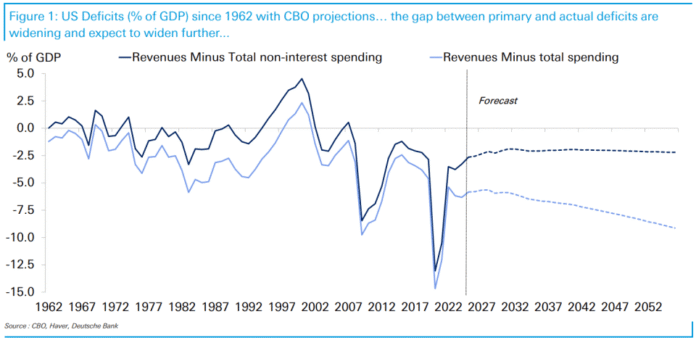
This year, the federal budget deficit is projected to exceed $2 trillion, with interest payments alone expected to reach $1 trillion. By 2036, these interest costs could grow to $2.1 trillion when national debt is anticipated to hit 120% of GDP. The Congressional Budget Office (CBO) suggests that the shortfall between revenue and expenditure, excluding interest, will remain around 2% of GDP despite increasing spending on social programmes.

Moreover, the gap between primary deficits and total deficits has widened since the COVID-19 pandemic, as significant government spending and rising interest rates have inflated the budget gap. If current trends persist, future administrations may find their fiscal policies increasingly restricted by the need to manage the burgeoning national debt.

Test Your Understanding

Start Quiz

Vocabulary List:
6 words · tap to reveal
ON

Accent

interest/ˈɪntrəst/noun
Money paid for using borrowed money

deficit/ˈdɛfɪsɪt/noun
When spending is more than money received

revenue/ˈrɛvəˌnuː/noun
Money that a government or company receives

expenditure/ɪkˈspɛndɪtʃɚ/noun
Money spent by a person or organization

fiscal/ˈfɪskəl/adjective
Related to government money and budgets

burgeoning/ˈbɜrdʒənɪŋ/adjective
Growing quickly and becoming more important

How much do you know?

What is the current national debt of the U.S. as of March 31?
$30 trillion
$31.27 trillion
$32 trillion
$29 trillion
What is the forecasted federal budget deficit for this year?
$1 trillion
$1.5 trillion
$2 trillion
$2.5 trillion
What is the debt-to-GDP ratio mentioned in the text?
98.5%
100.2%
95.3%
102.5%
By what year is the national debt anticipated to hit 120% of GDP?
2025
2030
2036
2040
How much are interest payments expected to reach by this year?
$500 billion
$750 billion
$1 trillion
$1.5 trillion
Which organization's analysts noted that interest payments are becoming a major factor in the national deficit?
Goldman Sachs
JP Morgan
Deutsche Bank
Bank of America
The U.S. national debt is forecasted to decrease in the coming decades.
The national debt has not surpassed the nation's economic output.
Interest payments alone are projected to reach $2.1 trillion by 2036.
The Congressional Budget Office indicated that the shortfall will remain around 2% of GDP.
The gap between primary deficits and total deficits has narrowed since the COVID-19 pandemic.
Future administrations may face fewer restrictions on their fiscal policies due to national debt.
The U.S. national debt is projected to significantly in the coming decades.
As of March 31, the debt-to-GDP ratio is %.
This year, the federal budget deficit is projected to exceed trillion.
Interest payments are expected to reach _____ trillion this year.
Interest payments are expected to reach trillion this year.
The anticipated national debt by 2036 is % of GDP.
The gap between primary deficits and total deficits has since the COVID-19 pandemic.
This question is required

Test Your Understanding

Start Quiz
Vocabulary List:
6 words · tap to reveal
ON
Accent
interest/ˈɪntrəst/noun
Money paid for using borrowed money
deficit/ˈdɛfɪsɪt/noun
When spending is more than money received
revenue/ˈrɛvəˌnuː/noun
Money that a government or company receives
expenditure/ɪkˈspɛndɪtʃɚ/noun
Money spent by a person or organization
fiscal/ˈfɪskəl/adjective
Related to government money and budgets
burgeoning/ˈbɜrdʒənɪŋ/adjective
Growing quickly and becoming more important

How much do you know?

What is the current national debt of the U.S. as of March 31?
$30 trillion
$31.27 trillion
$32 trillion
$29 trillion
What is the forecasted federal budget deficit for this year?
$1 trillion
$1.5 trillion
$2 trillion
$2.5 trillion
What is the debt-to-GDP ratio mentioned in the text?
98.5%
100.2%
95.3%
102.5%
By what year is the national debt anticipated to hit 120% of GDP?
2025
2030
2036
2040
How much are interest payments expected to reach by this year?
$500 billion
$750 billion
$1 trillion
$1.5 trillion
Which organization's analysts noted that interest payments are becoming a major factor in the national deficit?
Goldman Sachs
JP Morgan
Deutsche Bank
Bank of America
The U.S. national debt is forecasted to decrease in the coming decades.
The national debt has not surpassed the nation's economic output.
Interest payments alone are projected to reach $2.1 trillion by 2036.
The Congressional Budget Office indicated that the shortfall will remain around 2% of GDP.
The gap between primary deficits and total deficits has narrowed since the COVID-19 pandemic.
Future administrations may face fewer restrictions on their fiscal policies due to national debt.
The U.S. national debt is projected to significantly in the coming decades.
As of March 31, the debt-to-GDP ratio is %.
This year, the federal budget deficit is projected to exceed trillion.
Interest payments are expected to reach _____ trillion this year.
Interest payments are expected to reach trillion this year.
The anticipated national debt by 2036 is % of GDP.
The gap between primary deficits and total deficits has since the COVID-19 pandemic.
This question is required

Read More