Friday, May 15, 2026

Mars Express Reveals Ancient Waterway’s Dark Remains

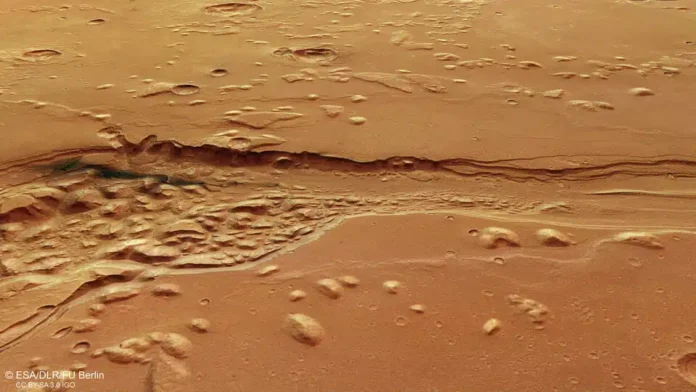
A newly released image from the European Space Agency (ESA) shows mysterious dark material in an ancient channel on Mars. This observation is significant because it provides insights into a region where water flowed billions of years ago.

The large channel, named Shalbatana Vallis, extends for nearly 800 miles (about 1,300 kilometres) across Mars. Scientists believe it formed when large amounts of liquid water carved into the rock during a wetter era around 3.5 billion years ago. The image shows a section of the valley that is about 6 miles wide and 0.3 miles deep. Over time, sediment and dust have filled parts of this channel, possibly making it shallower than it once was.

Shalbatana Vallis is one of the best examples of Mars’ ancient water history. Research has confirmed that rivers and lakes existed on the planet, significantly changing our understanding of its past. The channel preserves evidence of catastrophic floods, caused by underground water bursting onto the surface, which quickly carved these valleys.

The new image reveals dark volcanic ash along the valley floor, likely moved by strong winds. Although Mars has no active volcanoes now, it once experienced significant volcanic activity, leaving behind layers of ash. This ash highlights the dual influence of water and volcanic processes on Mars’s landscape.

The dark material is concentrated near a bulging area in the channel, which may have formed as underground ice melted. This region is scientifically valuable, linking volcanic activity and ancient ice with the possibility of past microbial life. As the ESA’s Mars Express spacecraft continues its work, it will provide further insights into these intriguing features of the Martian landscape.

Test Your Understanding

Start Quiz

Vocabulary List:
6 words · tap to reveal
ON

Accent

ancient/ˈeɪnʃənt/adjective
very old, from a long time ago

insights/ˈɪnˌsaɪts/noun
new or deeper understanding of something

sediment/ˈsɛdəmənt/noun
small pieces of rock or soil left by water

catastrophic/ˌkætəˈstrɑfɪk/adjective
causing great damage or sudden disaster

volcanic/vɑlˈkænɪk/adjective
connected to volcanoes or their eruptions

microbial/maɪˈkroʊbiəl/adjective
related to very small living things

How much do you know?

What does the newly released image from the European Space Agency (ESA) show?
An ancient volcanic eruption
Mysterious dark material in a channel
Water rivers on Mars
New ice formations
What is the name of the large channel on Mars?
Valles Marineris
Shalbatana Vallis
Olympus Mons
Hellas Planitia
How long is the Shalbatana Vallis channel?
500 miles
800 miles
1,000 miles
1,300 miles
What did scientists believe carved the large channel on Mars?
Wind erosion
Ice flow
Liquid water
Volcanic activity
What significant evidence does Shalbatana Vallis provide?
Evidence of current water flow
Ancient water history
Metals in soil
Active geological processes
What is the depth of the section of the valley shown in the image?
0.1 miles
0.3 miles
0.5 miles
1 mile
Shalbatana Vallis extends for nearly 1,000 miles across Mars.
Mars currently has active volcanoes.
The dark material in the image is from a recent volcanic eruption.
The study of Shalbatana Vallis has changed our understanding of Mars' past.
Rivers and lakes are confirmed to have existed on Mars.
The ESA's Mars Express spacecraft is investigating the Martian landscape.
The large channel on Mars is named Shalbatana Vallis and extends for nearly miles.
Shalbatana Vallis formed when large amounts of liquid water carved into the rock during a wetter era around billion years ago.
The new image highlights dark volcanic along the valley floor.
Evidence of catastrophic floods was caused by underground water bursting onto the in Mars.
Sediment and dust have potentially made the channel than it once was.
The region of dark material links volcanic activity and ancient ice with the possibility of past life.
This question is required

Test Your Understanding

Start Quiz
Vocabulary List:
6 words · tap to reveal
ON
Accent
ancient/ˈeɪnʃənt/adjective
very old, from a long time ago
insights/ˈɪnˌsaɪts/noun
new or deeper understanding of something
sediment/ˈsɛdəmənt/noun
small pieces of rock or soil left by water
catastrophic/ˌkætəˈstrɑfɪk/adjective
causing great damage or sudden disaster
volcanic/vɑlˈkænɪk/adjective
connected to volcanoes or their eruptions
microbial/maɪˈkroʊbiəl/adjective
related to very small living things

How much do you know?

What does the newly released image from the European Space Agency (ESA) show?
An ancient volcanic eruption
Mysterious dark material in a channel
Water rivers on Mars
New ice formations
What is the name of the large channel on Mars?
Valles Marineris
Shalbatana Vallis
Olympus Mons
Hellas Planitia
How long is the Shalbatana Vallis channel?
500 miles
800 miles
1,000 miles
1,300 miles
What did scientists believe carved the large channel on Mars?
Wind erosion
Ice flow
Liquid water
Volcanic activity
What significant evidence does Shalbatana Vallis provide?
Evidence of current water flow
Ancient water history
Metals in soil
Active geological processes
What is the depth of the section of the valley shown in the image?
0.1 miles
0.3 miles
0.5 miles
1 mile
Shalbatana Vallis extends for nearly 1,000 miles across Mars.
Mars currently has active volcanoes.
The dark material in the image is from a recent volcanic eruption.
The study of Shalbatana Vallis has changed our understanding of Mars' past.
Rivers and lakes are confirmed to have existed on Mars.
The ESA's Mars Express spacecraft is investigating the Martian landscape.
The large channel on Mars is named Shalbatana Vallis and extends for nearly miles.
Shalbatana Vallis formed when large amounts of liquid water carved into the rock during a wetter era around billion years ago.
The new image highlights dark volcanic along the valley floor.
Evidence of catastrophic floods was caused by underground water bursting onto the in Mars.
Sediment and dust have potentially made the channel than it once was.
The region of dark material links volcanic activity and ancient ice with the possibility of past life.
This question is required

Read More