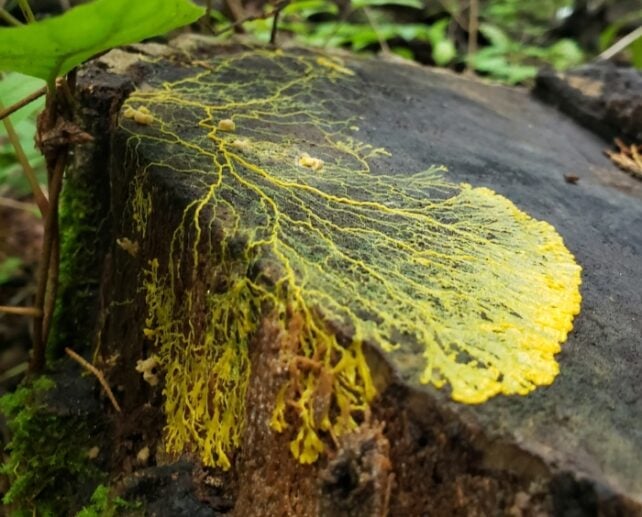
Slime molds are unusual, slippery creatures. They aren’t true molds or fungi. They live as either plasmodia or amoebae, not following the usual rules of other life forms.
Despite not having a brain or nervous system, slime molds show behavior that seems intelligent. But what makes them move together in a coordinated way? A new study gives some answers.
The most famous slime mold is Physarum polycephalum, a bright yellow organism often used in experiments. As a plasmodium, it’s mostly a big bag of cell nuclei and goo. Its flexible body allows it to move easily, unlike fungi.
When food runs out, P. polycephalum can move to find more. Surprisingly, they can solve mazes to get food and remember the way. Scientists in Germany and the US are learning how these molds make decisions without a central brain.
Slime molds dislike blue light, so researchers can trap them with barriers made of this light. However, if they’re hungry, they try to escape, sending out small protrusions to find a way through.
These molds move by rhythmic contractions, not nerves, which helps them adjust to their environment. In experiments, when faced with barriers, they explore and eventually escape by finding the longest path out. This movement seems like decision-making, but it relies on mechanical processes of fluid movement.
The study helps us understand how non-brain organisms adapt and behave using decentralized systems. The research was published in PRX Life.
Test Your Understanding
How much do you know?