Warning: foreach() argument must be of type array|object, false given in /home/u750883576/domains/esl-news.com/public_html/wp-content/plugins/gpt-post-quiz/includes/admin/class-gpoq-admin-4.php on line 450
Warning: foreach() argument must be of type array|object, false given in /home/u750883576/domains/esl-news.com/public_html/wp-content/plugins/td-composer/legacy/common/wp_booster/td_menu.php on line 88
NASA’s Voyager 1 spacecraft is set to reach a significant milestone on November 18, 2026, when it will be one light-day away from Earth. This distance is equivalent to about 16.1 billion miles, marking an important achievement in space exploration.
Voyager 1 is remarkable not only for its distance but also for its longevity. Launched from Florida in September 1977 during Jimmy Carter’s presidency, it has now been functioning for nearly 50 years. At present, Voyager 1 travels through deep space at a speed of 38,000 mph, making it the farthest human-made object from Earth. To put its distance in perspective, if someone drove at 50 mph, it would take around 37,000 years to reach Voyager 1’s current location.
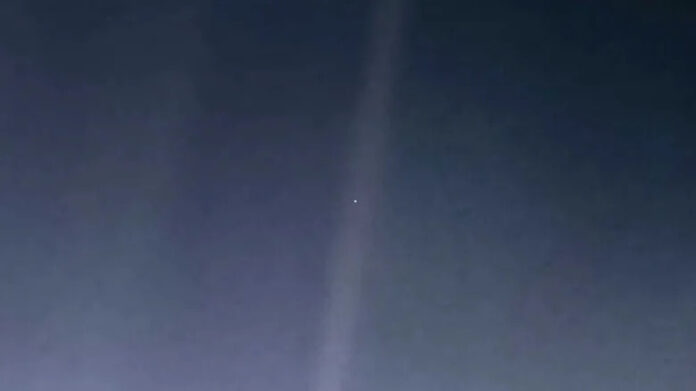
The mission initially focused on close encounters with Jupiter and Saturn, capturing vital data that led to discoveries such as Jupiter’s faint ring and volcanic activity on its moon, Io. Additionally, in 1990, Voyager 1 took the celebrated “Pale Blue Dot” photo of Earth.
Today, Voyager 1 still sends information back to NASA, although there is a 23-hour delay due to the vast distance. There was a communication issue in 2023 that took months to fix. Despite this, Voyager 1 continues to operate, maintaining a few scientific instruments that help study interstellar conditions.
Looking ahead, Voyager 2, its twin, will also wind down its operations to conserve power. It remains an extraordinary testament to NASA’s dedication to exploring our solar system and beyond.