

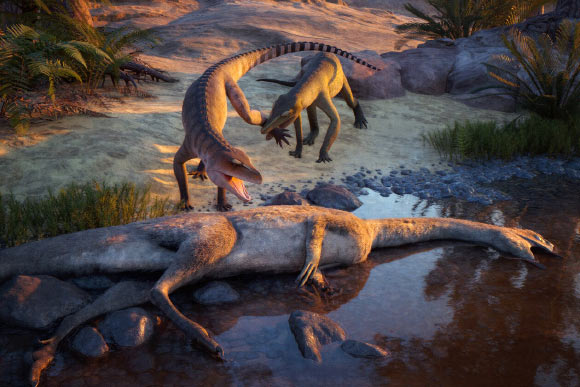
CT scans of an ancient specimen from the Yale Peabody Museum of Natural History have identified a new species of crocodylomorph, a group that includes modern crocodiles, known for its strong jaws. This discovery provides a valuable look into ecological specialization during the Late Triassic period.
The creature, named Eosphorosuchus lacrimosa, lived around 210 million years ago by rivers and lakes in what is now New Mexico. It was a swift predator, equipped with large back legs for running and smaller arms. Its short snout and robust skull were adapted for catching large prey effectively.
Paleontologist Dr. Bhart-Anjan Bhullar explained that this finding highlights the early diversification of crocodile ancestors. During this time, two major groups of reptiles were competing for dominance: the ancestors of modern crocodiles and those that led to birds, including dinosaurs. The dinosaurs of this era were lightweight and bipedal, while early crocodiles were powerful, four-legged hunters.
The holotype specimen of Eosphorosuchus lacrimosa includes parts of its skull, jaw, vertebrae, limbs, and protective armour. Although excavated in 1948, it had not been fully examined until now. The analysis positions it early in the crocodylomorph evolution, indicating that these features developed at the beginning of their history.
Researchers highlight that this discovery shows the early stages of ecological niche partitioning among similar predators. The team’s findings were published in the Proceedings of the Royal Society B this month.
Test Your Understanding
How much do you know?