Warning: foreach() argument must be of type array|object, false given in /home/u750883576/domains/esl-news.com/public_html/wp-content/plugins/gpt-post-quiz/includes/admin/class-gpoq-admin-4.php on line 450
Warning: foreach() argument must be of type array|object, false given in /home/u750883576/domains/esl-news.com/public_html/wp-content/plugins/td-composer/legacy/common/wp_booster/td_menu.php on line 88
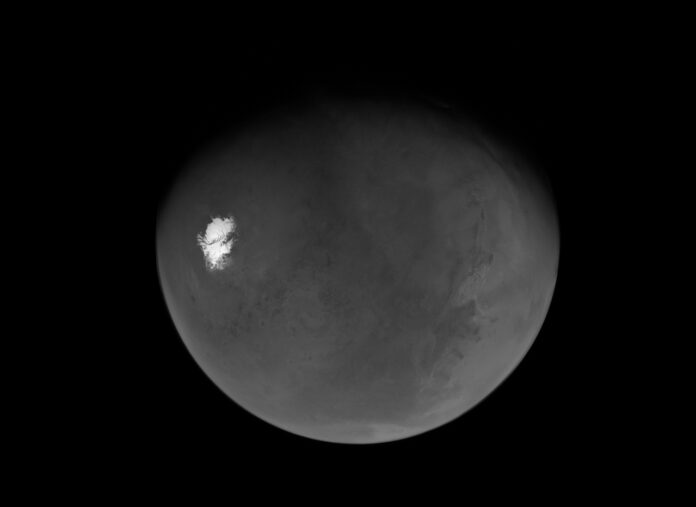
NASA’s Psyche spacecraft recently passed by Mars, capturing images of the planet from a unique viewpoint. This approach, from the side opposite the Sun, made Mars appear as a thin crescent. The thin Martian atmosphere was visible as sunlight illuminated dust clouds above the planet’s rust-coloured surface.
During its flyby on May 15, 2026, Psyche’s cameras provided an overhead view of Mars’ southern polar ice cap. Jim Bell, who leads the imager team at Arizona State University, reported that the spacecraft took thousands of images. These observations will assist scientists in calibrating the camera’s performance.
Additionally, Psyche’s magnetometer might have detected signs of the solar wind interacting with Mars’ upper atmosphere or its weak magnetic field. The spacecraft’s spectrometers are also set to analyse the chemical makeup of the Martian surface beneath its flight path.
Currently, many other missions are studying Mars, so significant new discoveries from Psyche’s data are unlikely. However, these flyby observations will help scientists refine their instruments by comparing them with existing data from other Mars missions.
While seeing a crescent Mars from Earth is impossible, the Psyche mission is expected to yield more significant results in the future. In three years, the spacecraft will approach asteroid Psyche, a large, metal-rich object. This phase will allow Psyche to survey the asteroid for a much longer time than the brief encounter it had with Mars.