Warning: foreach() argument must be of type array|object, false given in /home/u750883576/domains/esl-news.com/public_html/wp-content/plugins/gpt-post-quiz/includes/admin/class-gpoq-admin-4.php on line 450
Warning: foreach() argument must be of type array|object, false given in /home/u750883576/domains/esl-news.com/public_html/wp-content/plugins/td-composer/legacy/common/wp_booster/td_menu.php on line 88
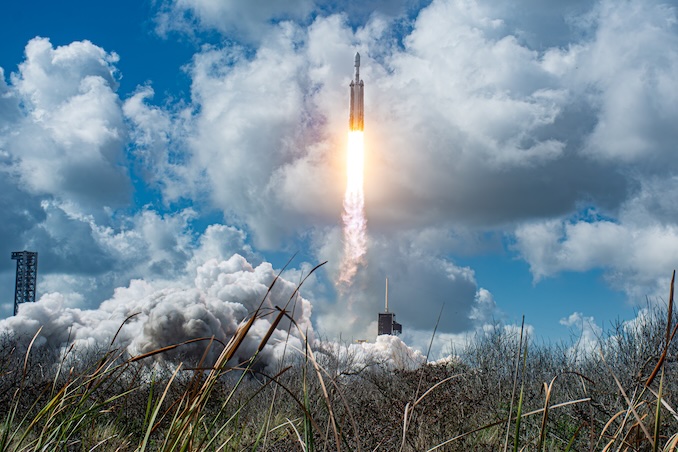
SpaceX’s Falcon Heavy rocket successfully launched on April 29, 2026, carrying the ViaSat-3 F3 satellite from NASA’s Kennedy Space Center. This launch marks the 12th flight of the Falcon Heavy since its debut in 2018 and demonstrates the rocket’s capabilities in providing advanced communications.
The Falcon Heavy, standing 70 metres tall and using 27 Merlin engines, lifted off at 10:13 a.m. EDT with an impressive thrust of 5 million pounds. Approximately 2.5 minutes after liftoff, the two side boostersseparated from the central core, which continued its mission to place the satellite into orbit. The side boosters safely returned to Earth, making landings at Cape Canaveral Space Force Station.
The successful deployment of the satellite occurred nearly five hours after launch, following a series of engine burns to guide it to its designated orbit. The ViaSat-3 F3 satellite is the final member of the ViaSat-3 constellation, which aims to enhance broadband capacity, focusing on the Asia-Pacific region. It is expected to add over one Terabit per second of capacity to the existing network.
Dave Abrahamian, Vice President at Viasat, highlighted the significance of this launch, noting the improvements in satellite technology over the past decade. The new satellites offer more flexibility than traditional models, allowing for better service across regions as demand changes. Following the launch, the satellite will undergo a two-month process to reach its operational position in orbit.
What was carried by the Falcon Heavy rocket during its launch on April 29, 2026?
Starlink satellites
ViaSat-3 F3 satellite
Hubble Space Telescope
Mars rover
What is the height of the Falcon Heavy rocket?
50 metres
70 metres
90 metres
110 metres
How many Merlin engines does the Falcon Heavy use?
17
20
27
30
At what time did the Falcon Heavy lift off on April 29, 2026?
10:00 a.m. EDT
10:13 a.m. EDT
10:30 a.m. EDT
10:45 a.m. EDT
Where did the side boosters of the Falcon Heavy land?
NASA Kennedy Space Center
Cape Canaveral Space Force Station
Fort Lauderdale
Orlando
What is the expected capacity addition of the ViaSat-3 F3 satellite to the existing network?
500 Megabits per second
1 Terabit per second
2 Terabits per second
10 Terabits per second
Falcon Heavy's launch on April 29, 2026, was its first flight.
The ViaSat-3 F3 satellite is part of a constellation aimed at enhancing broadband capacity.
The side boosters of Falcon Heavy did not return safely to Earth.
Dave Abrahamian is a Vice President at NASA.
The Falcon Heavy rocket uses 27 Merlin engines for its launch.
The satellite will take two weeks to reach its operational position in orbit after launch.
The Falcon Heavy rocket successfully launched on April 29, 2026, carrying the ViaSat-3 F3 satellite from NASA's Kennedy Space Center. This launch marks the flight of the Falcon Heavy.
The ViaSat-3 F3 satellite is designed to enhance broadband capacity, focusing on the region.
The Falcon Heavy lifted off with an impressive thrust of pounds.
The successful deployment of the satellite occurred nearly five after launch.
Following the launch, the satellite will undergo a process to reach its operational position in orbit.
The Falcon Heavy rocket uses Merlin engines to operate.
What was carried by the Falcon Heavy rocket during its launch on April 29, 2026?
Starlink satellites
ViaSat-3 F3 satellite
Hubble Space Telescope
Mars rover
What is the height of the Falcon Heavy rocket?
50 metres
70 metres
90 metres
110 metres
How many Merlin engines does the Falcon Heavy use?
17
20
27
30
At what time did the Falcon Heavy lift off on April 29, 2026?
10:00 a.m. EDT
10:13 a.m. EDT
10:30 a.m. EDT
10:45 a.m. EDT
Where did the side boosters of the Falcon Heavy land?
NASA Kennedy Space Center
Cape Canaveral Space Force Station
Fort Lauderdale
Orlando
What is the expected capacity addition of the ViaSat-3 F3 satellite to the existing network?
500 Megabits per second
1 Terabit per second
2 Terabits per second
10 Terabits per second
Falcon Heavy's launch on April 29, 2026, was its first flight.
The ViaSat-3 F3 satellite is part of a constellation aimed at enhancing broadband capacity.
The side boosters of Falcon Heavy did not return safely to Earth.
Dave Abrahamian is a Vice President at NASA.
The Falcon Heavy rocket uses 27 Merlin engines for its launch.
The satellite will take two weeks to reach its operational position in orbit after launch.
The Falcon Heavy rocket successfully launched on April 29, 2026, carrying the ViaSat-3 F3 satellite from NASA's Kennedy Space Center. This launch marks the flight of the Falcon Heavy.
The ViaSat-3 F3 satellite is designed to enhance broadband capacity, focusing on the region.
The Falcon Heavy lifted off with an impressive thrust of pounds.
The successful deployment of the satellite occurred nearly five after launch.
Following the launch, the satellite will undergo a process to reach its operational position in orbit.
The Falcon Heavy rocket uses Merlin engines to operate.