Friday, July 31, 2026

Sun Releases Three Major Solar Flares, Boosting Northern Lights Potential in U.S.

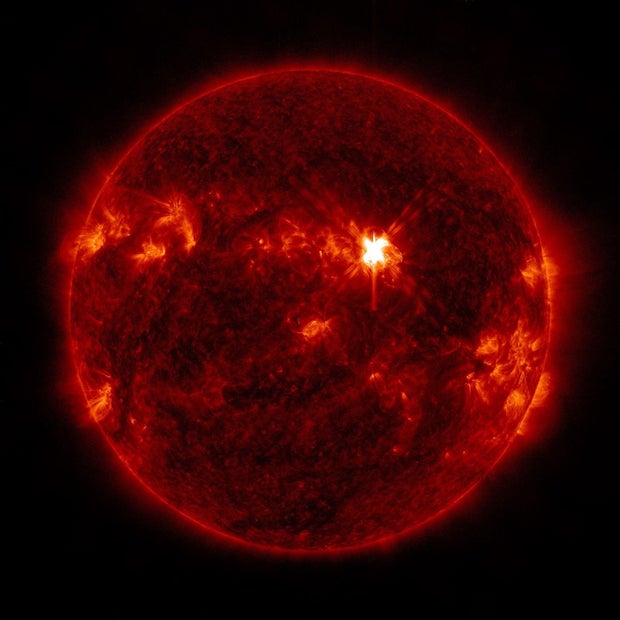
Three solar flares have erupted from the sun this week, sending energy and particles towards Earth. These powerful bursts may increase the chances of seeing the northern lights across the United States as they approach our planet.

Solar flares are massive explosions of electromagnetic radiation like X-rays and ultraviolet light that occur on the sun’s surface. According to NASA, these explosions are typically linked to solar magnetic storms, known as coronal mass ejections. When directed at Earth, they can disrupt technology, including communications.

The three flares released were expelled at slightly different angles but within a 24-hour period, as reported by the National Weather Service’s Space Weather Prediction Center. The centre expects these flares to combine before reaching Earth.

In an advisory, the centre expressed confidence that they would indeed arrive at our planet. However, the exact intensity and potential impacts of the flares remain uncertain. Scientists assess geomagnetic storms on a scale of 1 to 5, and this event is expected to fall in the middle category, either being classified as “strong” or “severe.”

NASA noted that one of the solar flares peaked at 07:30 ET on Wednesday, classifying it as “X1.0,” which indicates it is among the most powerful flares. These solar events can interfere with telecommunications, satellites, and may even affect astronauts in space.

As a result, the northern lights could be visible in the U.S. on Thursday and Friday, with strong geomagnetic storms sometimes causing auroras to appear further south than usual.

Test Your Understanding

Start Quiz

Vocabulary List:
6 words · tap to reveal
ON

Accent

erupted/ɪˈrʌptɪd/verb
broke out suddenly with strong force

particles/ˈpɑɹtɪkəlz/noun
very small pieces of matter or material

radiation/ˌreɪdiˈeɪʃən/noun
energy that moves as waves or particles

geomagnetic/ˌdʒioʊməˈɡnɛtɪk/adjective
connected to Earth's magnetic field or forces

disrupt/dɪsˈrʌpt/verb
interrupt or damage the normal working of

advisory/ədˈvaɪzəri/noun
official warning or information about a danger

How much do you know?

What is a solar flare?
A type of storm on Earth
A massive explosion of electromagnetic radiation
A weather phenomenon
A type of satellite
How many solar flares erupted from the sun this week?
One
Two
Three
Four
What is the expected category of the geomagnetic storms caused by the flares?
1 to 2
3 to 4
5
Strong or Severe
When did one of the solar flares peak?
08:30 ET on Wednesday
07:30 ET on Wednesday
06:30 ET on Tuesday
09:30 ET on Thursday
What can solar flares disrupt?
Weather patterns
Technology including communications
Human health
Animal behavior
According to the advisory from the National Weather Service, what is uncertain?
The exact time of arrival
The exact intensity and potential impacts
The number of flares
The geographical area affected
Solar flares are caused by solar magnetic storms.
The three solar flares were expelled over a week.
Geomagnetic storms are assessed on a scale from 1 to 5.
The northern lights are expected to be visible on Tuesday and Wednesday.
Solar flares can affect astronauts in space.
NASA predicts that the solar flares will have a minimal impact.
Three solar flares have erupted from the sun this week, sending energy and particles towards Earth, potentially allowing us to see the northern lights on and .
According to NASA, one of the solar flares peaked at 07:30 ET on Wednesday, classifying it as .
Solar flares can disrupt technology, including .
The expected geomagnetic storms are classified either as 'strong' or .
These solar events can cause to appear further south than usual.
The flares were reported by the National Weather Service's Space Weather Center.
This question is required

Test Your Understanding

Start Quiz
Vocabulary List:
6 words · tap to reveal
ON
Accent
erupted/ɪˈrʌptɪd/verb
broke out suddenly with strong force
particles/ˈpɑɹtɪkəlz/noun
very small pieces of matter or material
radiation/ˌreɪdiˈeɪʃən/noun
energy that moves as waves or particles
geomagnetic/ˌdʒioʊməˈɡnɛtɪk/adjective
connected to Earth's magnetic field or forces
disrupt/dɪsˈrʌpt/verb
interrupt or damage the normal working of
advisory/ədˈvaɪzəri/noun
official warning or information about a danger

How much do you know?

What is a solar flare?
A type of storm on Earth
A massive explosion of electromagnetic radiation
A weather phenomenon
A type of satellite
How many solar flares erupted from the sun this week?
One
Two
Three
Four
What is the expected category of the geomagnetic storms caused by the flares?
1 to 2
3 to 4
5
Strong or Severe
When did one of the solar flares peak?
08:30 ET on Wednesday
07:30 ET on Wednesday
06:30 ET on Tuesday
09:30 ET on Thursday
What can solar flares disrupt?
Weather patterns
Technology including communications
Human health
Animal behavior
According to the advisory from the National Weather Service, what is uncertain?
The exact time of arrival
The exact intensity and potential impacts
The number of flares
The geographical area affected
Solar flares are caused by solar magnetic storms.
The three solar flares were expelled over a week.
Geomagnetic storms are assessed on a scale from 1 to 5.
The northern lights are expected to be visible on Tuesday and Wednesday.
Solar flares can affect astronauts in space.
NASA predicts that the solar flares will have a minimal impact.
Three solar flares have erupted from the sun this week, sending energy and particles towards Earth, potentially allowing us to see the northern lights on and .
According to NASA, one of the solar flares peaked at 07:30 ET on Wednesday, classifying it as .
Solar flares can disrupt technology, including .
The expected geomagnetic storms are classified either as 'strong' or .
These solar events can cause to appear further south than usual.
The flares were reported by the National Weather Service's Space Weather Center.
This question is required

Read More