Sunday, May 10, 2026

Vera C. Rubin Observatory Identifies 11,000 New Asteroids

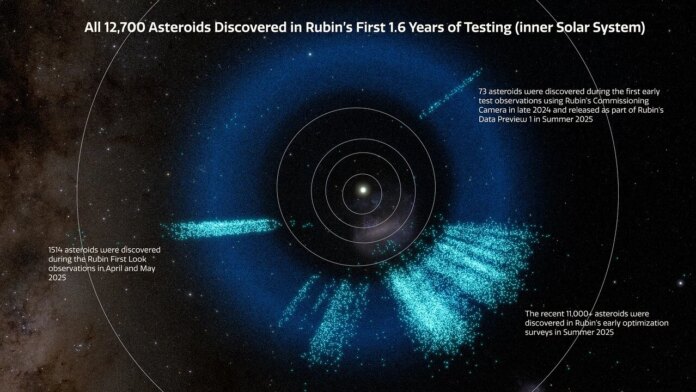
The Vera C. Rubin Observatory, located in Chile, aims to explore our Solar System. It will collect about 30 petabytes of data over ten years as part of its Legacy Survey of Space and Time (LSST). Scientists have already discovered 11,000 new asteroids with early data from the Observatory. The International Astronomical Union’s Minor Planet Center confirmed these discoveries.

This is the biggest number of new asteroids found in one year. The observations came from one million checks over six weeks, capturing over 11,000 new and 80,000 known asteroids. The early results show the power of Rubin’s advanced tools. When the LSST starts next year, it will further change the way we study the Solar System.

The dataset includes 33 new near-Earth objects, some of which could be dangerous in the future, but none currently threaten Earth. Rubin may discover nearly 90,000 new near-Earth objects, increasing our knowledge significantly.

Research teams, including Matthew Holman from Harvard, used special software to find these distant objects. The unique features of the Rubin Observatory allow it to detect very faint objects more effectively than previous telescopes. People can visit the Rubin Orbitviewer site to see and learn about the new discoveries.


Test Your Understanding

Start Quiz

Vocabulary List:
6 words · tap to reveal
ON

Accent

asteroids/ˈæstərɔɪdz/noun
small rocky objects that orbit the Sun

detect/dɪˈtɛkt/verb
find or notice something not easily seen

dataset/ˈdeɪtəˌsɛt/noun
a collection of related information or data

petabytes/ˈpɛtəˌbaɪts/noun
very large amounts of digital information storage

confirmed/kənˈfɝmd/verb
said to be true after checking

survey/ˈsɝˌveɪ/noun
a detailed study to collect information

How much do you know?

What is the primary aim of the Vera C. Rubin Observatory?
To explore the Solar System
To study distant galaxies
To examine black holes
To observe the Milky Way
How much data will the Vera C. Rubin Observatory collect over ten years?
10 petabytes
20 petabytes
30 petabytes
40 petabytes
How many new asteroids have been discovered using early data from the Observatory?
1,100
11,000
100,000
8,000
What is the name of the survey conducted by the Vera C. Rubin Observatory?
Legacy Survey of Space and Time
Asteroid Discovery Initiative
Near-Earth Object Program
Galaxy Mapping Project
How many new near-Earth objects does Rubin aim to discover?
5,000
10,000
90,000
50,000
Which institution is associated with the researcher Matthew Holman?
Harvard
MIT
Stanford
Yale
The Vera C. Rubin Observatory is located in Argentina.
The LSST will change the way we study the Solar System.
The Minor Planet Center confirmed the discovery of 11,000 new asteroids.
Rubin Observatory uses outdated technology to detect faint objects.
None of the new near-Earth objects currently threaten Earth.
Data collection at the Vera C. Rubin Observatory will last for five years.
The Vera C. Rubin Observatory aims to explore our Solar System and will collect about 30 petabytes of data over .
Scientists have discovered new asteroids with early data from the Observatory.
The LSST starts next year and it will change the way we study the .
Rubin may discover nearly new near-Earth objects, increasing our knowledge significantly.
The unique features of Rubin Observatory allow it to detect very faint objects more effectively than previous .
People can visit the Rubin to see and learn about the new discoveries.
This question is required

Test Your Understanding

Start Quiz
Vocabulary List:
6 words · tap to reveal
ON
Accent
asteroids/ˈæstərɔɪdz/noun
small rocky objects that orbit the Sun
detect/dɪˈtɛkt/verb
find or notice something not easily seen
dataset/ˈdeɪtəˌsɛt/noun
a collection of related information or data
petabytes/ˈpɛtəˌbaɪts/noun
very large amounts of digital information storage
confirmed/kənˈfɝmd/verb
said to be true after checking
survey/ˈsɝˌveɪ/noun
a detailed study to collect information

How much do you know?

What is the primary aim of the Vera C. Rubin Observatory?
To explore the Solar System
To study distant galaxies
To examine black holes
To observe the Milky Way
How much data will the Vera C. Rubin Observatory collect over ten years?
10 petabytes
20 petabytes
30 petabytes
40 petabytes
How many new asteroids have been discovered using early data from the Observatory?
1,100
11,000
100,000
8,000
What is the name of the survey conducted by the Vera C. Rubin Observatory?
Legacy Survey of Space and Time
Asteroid Discovery Initiative
Near-Earth Object Program
Galaxy Mapping Project
How many new near-Earth objects does Rubin aim to discover?
5,000
10,000
90,000
50,000
Which institution is associated with the researcher Matthew Holman?
Harvard
MIT
Stanford
Yale
The Vera C. Rubin Observatory is located in Argentina.
The LSST will change the way we study the Solar System.
The Minor Planet Center confirmed the discovery of 11,000 new asteroids.
Rubin Observatory uses outdated technology to detect faint objects.
None of the new near-Earth objects currently threaten Earth.
Data collection at the Vera C. Rubin Observatory will last for five years.
The Vera C. Rubin Observatory aims to explore our Solar System and will collect about 30 petabytes of data over .
Scientists have discovered new asteroids with early data from the Observatory.
The LSST starts next year and it will change the way we study the .
Rubin may discover nearly new near-Earth objects, increasing our knowledge significantly.
The unique features of Rubin Observatory allow it to detect very faint objects more effectively than previous .
People can visit the Rubin to see and learn about the new discoveries.

This question is required

Read More