

Wednesday, April 29, 2026

‘Virtual Cell’ Reveals Key Process in Bacterial Division

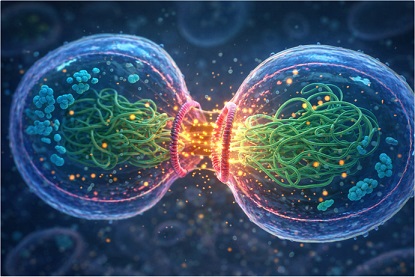
Researchers have successfully simulated nearly all chemical reactions occurring in a living bacterial cell. This groundbreaking virtual model illustrates the processes of DNA copying and cell division, offering insights into the molecular interactions that contribute to life.

Zane Thornburg, a computational biophysicist at the University of Illinois in Urbana-Champaign, co-led the study published on 9 March in Cell. He explained that understanding the interplay of proteins, nucleic acids, fats, and other molecules within a cell’s wall is crucial to comprehending the essence of life itself.

To create the simulation, Thornburg selected a simplistic bacterial organism, JCVI-Syn3a, which boasts a “minimal” genome consisting of just 493 genes. This organism was developed by trimming away over 400 non-essential genes from the parasite Mycoplasma mycoides.

The detailed three-dimensional simulation incorporated various cellular components such as DNA, proteins, and ribosomes, capturing their dynamic behaviour over time. Key molecular interactions, like those involving a DNA-copying enzyme, were based on real-world measurements. However, some aspects were approximated due to limited knowledge; for example, certain JCVI-Syn3a genes were represented as inert spheres.

Initially, the team faced challenges, such as the genome deteriorating faster than it could replicate. After adjustments, they allowed the model to run during the US Thanksgiving holiday, only to return to find that a complete cell cycle had progressed. Thornburg remarked on the significant advancement this represented.

The simulation accurately reflected real-life cellular processes, including the transformation in shape during division. The virtual cell took 105 minutes to divide, mirroring the reproductive timeline of actual cells, though the simulation required six days on a supercomputer, highlighting the complexity involved.

Bernhard Palsson, a bioengineer at the University of California, San Diego, praised this achievement, noting the significance of coherently representing diverse cellular activities during the cell cycle. Future directions for this research may explore further optimization and refinement of the simulation’s components.

Test Your Understanding

Start Quiz

Vocabulary List:
6 words · tap to reveal
ON

Accent

simulated/ˈsɪmjəˌleɪtɪd/verb
made to act like the real thing

interplay/ˈɪntərpleɪ/noun
how different things affect each other

genome/ˈdʒiːnoʊm/noun
all the genes in a living thing

replicate/ˈrɛplɪkeɪt/verb
copy itself to make more cells

inert/ɪˈnɝt/adjective
not moving and not reacting with others

optimization/ˌɑptəmaɪˈzeɪʃən/noun
making something work better or more efficiently

How much do you know?

What is the name of the bacterial organism used for the simulation?
JCVI-Syn3a
Mycoplasma mycoides
E. coli
Bacillus subtilis
How many genes does the JCVI-Syn3a organism have?
493
400
200
600
Which journal published the study?
Nature
Cell
Science
PLOS Biology
How long did the simulation take to run on a supercomputer?
2 days
4 days
6 days
8 days
Who co-led the study at the University of Illinois?
Bernhard Palsson
Zane Thornburg
Emma Watson
John Smith
What key process does the simulation help illustrate?
Photosynthesis
Respiration
DNA copying and cell division
Protein synthesis
The simulation was published on 9 March.
The JCVI-Syn3a organism was created by adding genes to Mycoplasma mycoides.
The virtual cell took 105 minutes to divide in the simulation.
The researchers found that the genome replicated faster than it could deteriorate.
The simulation accurately reflects real-life cellular processes.
Zane Thornburg is a computational physicist.
The simulation illustrates the processes of DNA copying and cell division offering insights into the interactions.
Bernhard Palsson praised the significance of coherently representing diverse cellular during the cell cycle.
The JCVI-Syn3a organism has a minimal genome consisting of just genes.
The simulation required days on a supercomputer.
Understanding the interplay of proteins nucleic acids fats and other molecules is crucial to comprehending the essence of itself.
The detailed three-dimensional simulation incorporated various cellular components such as DNA proteins and .
This question is required

Test Your Understanding

Start Quiz
Vocabulary List:
6 words · tap to reveal
ON
Accent
simulated/ˈsɪmjəˌleɪtɪd/verb
made to act like the real thing
interplay/ˈɪntərpleɪ/noun
how different things affect each other
genome/ˈdʒiːnoʊm/noun
all the genes in a living thing
replicate/ˈrɛplɪkeɪt/verb
copy itself to make more cells
inert/ɪˈnɝt/adjective
not moving and not reacting with others
optimization/ˌɑptəmaɪˈzeɪʃən/noun
making something work better or more efficiently

How much do you know?

What is the name of the bacterial organism used for the simulation?
JCVI-Syn3a
Mycoplasma mycoides
E. coli
Bacillus subtilis
How many genes does the JCVI-Syn3a organism have?
493
400
200
600
Which journal published the study?
Nature
Cell
Science
PLOS Biology
How long did the simulation take to run on a supercomputer?
2 days
4 days
6 days
8 days
Who co-led the study at the University of Illinois?
Bernhard Palsson
Zane Thornburg
Emma Watson
John Smith
What key process does the simulation help illustrate?
Photosynthesis
Respiration
DNA copying and cell division
Protein synthesis
The simulation was published on 9 March.
The JCVI-Syn3a organism was created by adding genes to Mycoplasma mycoides.
The virtual cell took 105 minutes to divide in the simulation.
The researchers found that the genome replicated faster than it could deteriorate.
The simulation accurately reflects real-life cellular processes.
Zane Thornburg is a computational physicist.
The simulation illustrates the processes of DNA copying and cell division offering insights into the interactions.
Bernhard Palsson praised the significance of coherently representing diverse cellular during the cell cycle.
The JCVI-Syn3a organism has a minimal genome consisting of just genes.
The simulation required days on a supercomputer.
Understanding the interplay of proteins nucleic acids fats and other molecules is crucial to comprehending the essence of itself.
The detailed three-dimensional simulation incorporated various cellular components such as DNA proteins and .
This question is required

Read More


