Tuesday, April 28, 2026

How Tumours Evaded the Immune System for Years

Researchers have found a way pancreatic cancer cells evade immune detection, potentially paving the way for new treatments. This cancer, particularly aggressive, is known for its ability to grow quickly without triggering a response from the body’s immune system.

An international team led by the University of Würzburg has discovered what they call a “molecular invisibility switch.” The team’s study reveals that a protein called MYC, known for promoting cell growth, can also suppress immune signaling. This finding was published in the journal Cell.

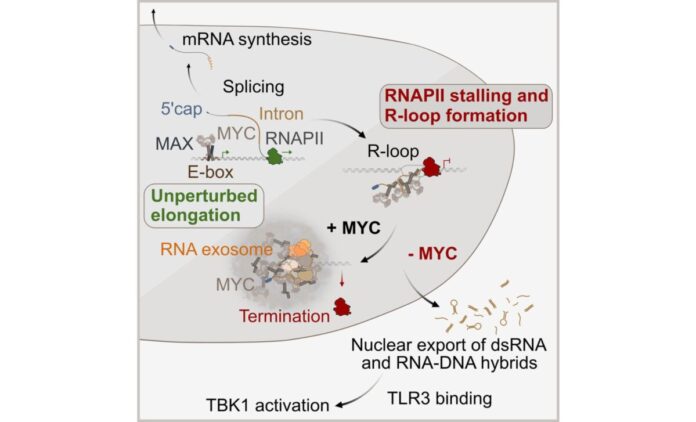
Typically, MYC drives cell division by binding to DNA. However, under stress, it switches function, moving from DNA to RNA. In this state, it forms clusters around RNA-DNA hybrids, which are structures known as R-loops.

The study highlights that MYC has several RNA-binding regions. One region, RBRIII, plays a crucial role by attracting an RNA-degrading complex to break down abnormal RNA, preventing immune system activation.

Normally, RNA-DNA hybrids can trigger immune responses through pathways involving receptors like TLR3. The researchers found that MYC, via RBRIII, prevents such pathways, stopping the immune system from recognizing the cancer.

In experiments on mice, only tumors with fully functional MYC continued to grow substantially. Mutations in the RBRIII region led to tumor shrinkage, but only in mice with working immune systems.

These findings suggest that while MYC’s role in cell growth is intact, its ability to hide tumors from the immune system can be disrupted. This could enable treatments that expose cancers to immune attack without damaging other MYC functions.

Test Your Understanding

Start Quiz

Vocabulary List:
6 words · tap to reveal
ON

Accent

Evade/ɪˈveɪd/verb
To escape or avoid something especially by cleverness or trickery.

Aggressive/əˈɡrɛsɪv/adjective
Quick to act; ready to attack; characterized by a strong tendency to increase or advance.

Suppress/səˈprɛs/verb
To put an end to the activities of or to prevent from being expressed.

Activation/ˌæktɪˈveɪʃən/noun
The process of making something active or operative.

Complex/ˈkɒmplɛks/noun
A group of related parts or elements working together.

Pathways/ˈpæθweɪz/noun
Routes taken by signals or processes within a biological system.

How much do you know?

What is the role of the protein MYC?
Promoting immune response
Promoting cell growth
Breaking down RNA
None of the above
What does MYC suppress?
Cell growth
Immune signaling
RNA synthesis
DNA binding
Which structure is formed by MYC when under stress?
DNA-DNA hybrids
RNA-RNA hybrids
RNA-DNA hybrids
Protein clusters
What is the function of the RBRIII region of MYC?
Attract immune cells
Prevent RNA degradation
Attract an RNA-degrading complex
Promote cell division
In which publication was the study about MYC and pancreatic cancer cells published?
Nature
Cell
The Lancet
Cancer Research
What happens to tumors when there are mutations in the RBRIII region?
They grow larger
They shrink
They remain the same
They become immune to treatment
Pancreatic cancer cells can evade immune detection.
MYC only functions to promote immune signaling.
The University of Würzburg led the research on pancreatic cancer cells.
RNA-DNA hybrids can trigger immune responses.
MYC functions to promote both cell growth and immune system activation.
Only tumors with dysfunctional MYC continue to grow substantially in mice.
MYC is known for promoting cell growth and also immune signaling.
The research reveals a 'molecular invisibility switch' that allows tumors to evade .
MYC can switch from DNA to under stress.
The study found that RBRIII attracts an complex.
Only tumors with fully functional MYC showed substantial .
In mice with working immune systems, mutations in RBRIII led to tumor .
This question is required

Test Your Understanding

Start Quiz
Vocabulary List:
6 words · tap to reveal
ON
Accent
Evade/ɪˈveɪd/verb
To escape or avoid something especially by cleverness or trickery.
Aggressive/əˈɡrɛsɪv/adjective
Quick to act; ready to attack; characterized by a strong tendency to increase or advance.
Suppress/səˈprɛs/verb
To put an end to the activities of or to prevent from being expressed.
Activation/ˌæktɪˈveɪʃən/noun
The process of making something active or operative.
Complex/ˈkɒmplɛks/noun
A group of related parts or elements working together.
Pathways/ˈpæθweɪz/noun
Routes taken by signals or processes within a biological system.

How much do you know?

What is the role of the protein MYC?
Promoting immune response
Promoting cell growth
Breaking down RNA
None of the above
What does MYC suppress?
Cell growth
Immune signaling
RNA synthesis
DNA binding
Which structure is formed by MYC when under stress?
DNA-DNA hybrids
RNA-RNA hybrids
RNA-DNA hybrids
Protein clusters
What is the function of the RBRIII region of MYC?
Attract immune cells
Prevent RNA degradation
Attract an RNA-degrading complex
Promote cell division
In which publication was the study about MYC and pancreatic cancer cells published?
Nature
Cell
The Lancet
Cancer Research
What happens to tumors when there are mutations in the RBRIII region?
They grow larger
They shrink
They remain the same
They become immune to treatment
Pancreatic cancer cells can evade immune detection.
MYC only functions to promote immune signaling.
The University of Würzburg led the research on pancreatic cancer cells.
RNA-DNA hybrids can trigger immune responses.
MYC functions to promote both cell growth and immune system activation.
Only tumors with dysfunctional MYC continue to grow substantially in mice.
MYC is known for promoting cell growth and also immune signaling.
The research reveals a 'molecular invisibility switch' that allows tumors to evade .
MYC can switch from DNA to under stress.
The study found that RBRIII attracts an complex.
Only tumors with fully functional MYC showed substantial .
In mice with working immune systems, mutations in RBRIII led to tumor .
This question is required

Read More