Warning: foreach() argument must be of type array|object, false given in /home/u750883576/domains/esl-news.com/public_html/wp-content/plugins/gpt-post-quiz/includes/admin/class-gpoq-admin-4.php on line 450
Warning: foreach() argument must be of type array|object, false given in /home/u750883576/domains/esl-news.com/public_html/wp-content/plugins/td-composer/legacy/common/wp_booster/td_menu.php on line 88
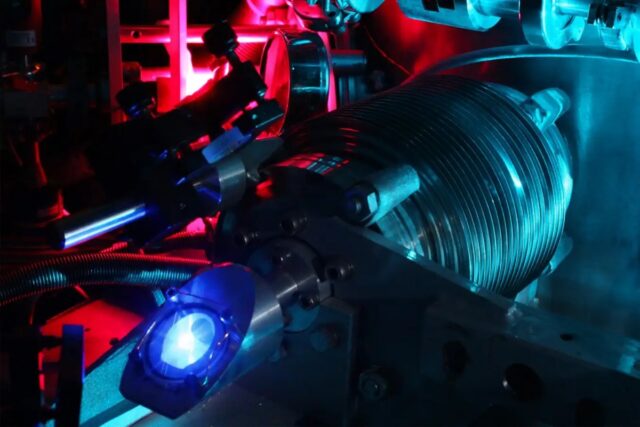
In recent studies, scientists worked on measuring the proton’s size. They did this in a vacuum chamber using hydrogen atoms. Their goal was to find the proton’s charge radius, which is very small.
In 2010, a different team found the proton’s radius to be 0.84 femtometers. A femtometer is one million-billionths of a meter. Other experiments tried to confirm this result but had different findings. Some studies agreed with the 2010 finding, while others showed a larger size.
In 2019, scientists from York University also measured the protonradius. They found it to be 0.833 femtometers. This again matched the smaller size from 2010.
Now, two new papers showed similar results using lasers and hydrogen atoms. They measured energy changes to find the proton’s size. Based on their findings, the proton’s radius is about 0.84 femtometers. This agrees with the earlier 2010 study.
A physicist said the proton’s size should be the same no matter how you measure it. These new studies support the original findings from 2010.
Test Your Understanding
Start Quiz
Vocabulary List:
6 words · tap to reveal
ON
Accent
proton/ˈproʊtɑn/noun
a very small particle inside an atom's nucleus
radius/ˈreɪdiəs/noun
the distance from the center to the edge
femtometer/ˈfɛmtoʊˌmiːtər/noun
a unit of length equal to one million-billionth meter