Warning: foreach() argument must be of type array|object, false given in /home/u750883576/domains/esl-news.com/public_html/wp-content/plugins/gpt-post-quiz/includes/admin/class-gpoq-admin-4.php on line 450
Warning: foreach() argument must be of type array|object, false given in /home/u750883576/domains/esl-news.com/public_html/wp-content/plugins/td-composer/legacy/common/wp_booster/td_menu.php on line 88
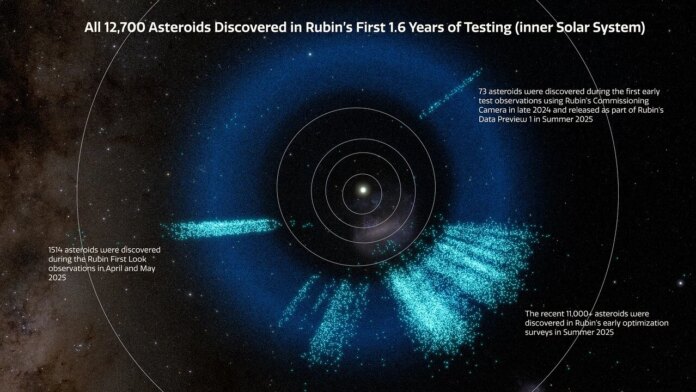
The Vera C. Rubin Observatory, located in Chile, aims to explore our Solar System. It will collect about 30 petabytes of data over ten years as part of its Legacy Survey of Space and Time (LSST). Scientists have already discovered 11,000 new asteroids with early data from the Observatory. The International Astronomical Union’s Minor Planet Center confirmed these discoveries.
This is the biggest number of new asteroids found in one year. The observations came from one million checks over six weeks, capturing over 11,000 new and 80,000 known asteroids. The early results show the power of Rubin’s advanced tools. When the LSST starts next year, it will further change the way we study the Solar System.
The dataset includes 33 new near-Earth objects, some of which could be dangerous in the future, but none currently threaten Earth. Rubin may discover nearly 90,000 new near-Earth objects, increasing our knowledge significantly.
Research teams, including Matthew Holman from Harvard, used special software to find these distant objects. The unique features of the Rubin Observatory allow it to detect very faint objects more effectively than previous telescopes. People can visit the Rubin Orbitviewer site to see and learn about the new discoveries.