Thursday, April 23, 2026

Innovative Plastic Film Destroys Viruses Upon Contact

Every day, people touch many surfaces like kitchen counters, bus handrails, work desks, and phone screens. Germs and viruses can spread easily through these contact points, often infecting people when they touch their face after contact with contaminated surfaces.

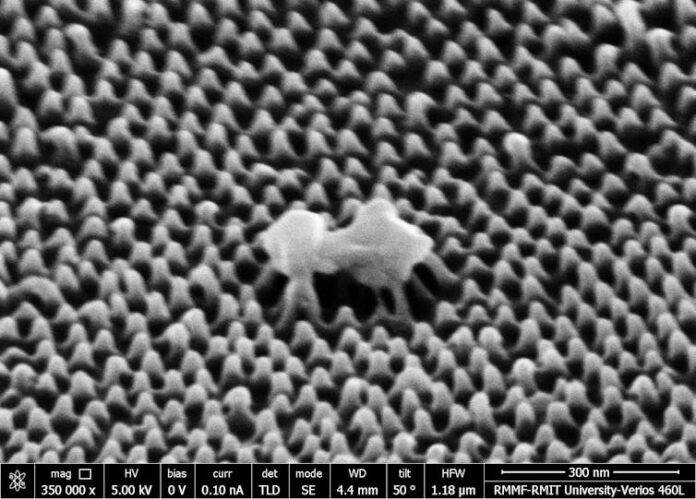
While surfaces can be cleaned with chemical products, these can harm the environment and may lead to germs becoming resistant to medicines. Researchers recently published a study in Advanced Science where they developed a thin plastic surface with nanoscale features, mimicking the surface of insect wings. This can physically destroy viruses, such as the human parainfluenza virus type 3 (hPIV-3), offering a more environmentally friendly way to stop disease spread.

Typical disinfection involves cleaning surfaces, which can be difficult because disinfectants need to remain wet for a while to work. Surfaces also quickly become contaminated again. Existing antiviral coatings, often using materials like graphene, can pose health risks and become less effective as their active ingredients weaken.

The journey to develop this new virus-bursting surface began over a decade ago. Initially, researchers aimed for smooth surfaces to repel germs, but discovered that rough, textured surfaces inspired by insect wings were more effective at killing bacteria and viruses through physical means.

In the latest study, scientists created a lightweight and flexible film with tiny pillars that tear apart virus particles. Tests showed that up to 94% of hPIV-3 particles were destroyed within an hour. This material could be scaled for various uses, from food packaging to public transport and medical equipment. Despite their durability, these surfaces will eventually degrade, but they offer a promising alternative to chemical methods in fighting germs.


Test Your Understanding

Start Quiz

Vocabulary List:
6 words · tap to reveal
ON

Accent

contaminated/kənˈtæməˌneɪtɪd/adjective
made dirty or unsafe with germs or chemicals

nanoscale/ˈneɪnoʊskeɪl/adjective
extremely small; much smaller than cells

mimicking/ˈmɪmɪkɪŋ/verb
copying the way something looks or works

physically/ˈfɪzɪkli/adverb
by using real things or physical forces

pillars/ˈpɪlərz/noun
small upright parts that stand up from surfaces

resistant/rɪˈzɪstənt/adjective
able to fight against something harmful

How much do you know?

What surfaces do people commonly touch that can spread germs?
Kitchen counters
Smartphones
Bus handrails
All of the above
What did researchers develop as a new method for virus destruction?
Chemical disinfectants
Smooth surfaces
Thin plastic surfaces with nanoscale features
Graphene coatings
What virus type was specifically mentioned in relation to the new surface developed by researchers?
hPIV-3
COVID-19
Influenza
Ebola
How long did the tests show it took to destroy up to 94% of hPIV-3 particles?
10 minutes
30 minutes
1 hour
24 hours
What is a major downside of using chemical disinfectants?
They are too cheap
They can harm the environment
They are ineffective against viruses
They are hard to find
What was the original goal of the researchers over a decade ago?
To create a chemical disinfectant
To create smooth surfaces to repel germs
To invent new viruses
To find a use for graphene
Researchers have found that smooth surfaces are more effective at killing bacteria and viruses.
Chemical cleaning products can lead to germs becoming resistant to medicines.
The new virus-bursting surface offers a promising alternative to chemical methods in fighting germs.
Surfaces need to remain wet for a long time to be effective when using disinfectants.
The developed thin plastic surface is heavier and less flexible than traditional surfaces.
The study was published in a journal titled Advanced Science.
Every day, people touch many surfaces like kitchen counters, handrails, work desks, and phone screens.
Researchers developed a thin plastic surface with nanoscale features mimicking the of insect wings.
Typical disinfection involves cleaning surfaces, but disinfectants need to remain wet for a while to .
Up to of hPIV-3 particles were destroyed within an hour using the new surface.
Existing antiviral coatings can become less effective as their active ingredients .
Despite their durability, these surfaces will eventually , but they provide a promising alternative.
This question is required

Test Your Understanding

Start Quiz
Vocabulary List:
6 words · tap to reveal
ON
Accent
contaminated/kənˈtæməˌneɪtɪd/adjective
made dirty or unsafe with germs or chemicals
nanoscale/ˈneɪnoʊskeɪl/adjective
extremely small; much smaller than cells
mimicking/ˈmɪmɪkɪŋ/verb
copying the way something looks or works
physically/ˈfɪzɪkli/adverb
by using real things or physical forces
pillars/ˈpɪlərz/noun
small upright parts that stand up from surfaces
resistant/rɪˈzɪstənt/adjective
able to fight against something harmful

How much do you know?

What surfaces do people commonly touch that can spread germs?
Kitchen counters
Smartphones
Bus handrails
All of the above
What did researchers develop as a new method for virus destruction?
Chemical disinfectants
Smooth surfaces
Thin plastic surfaces with nanoscale features
Graphene coatings
What virus type was specifically mentioned in relation to the new surface developed by researchers?
hPIV-3
COVID-19
Influenza
Ebola
How long did the tests show it took to destroy up to 94% of hPIV-3 particles?
10 minutes
30 minutes
1 hour
24 hours
What is a major downside of using chemical disinfectants?
They are too cheap
They can harm the environment
They are ineffective against viruses
They are hard to find
What was the original goal of the researchers over a decade ago?
To create a chemical disinfectant
To create smooth surfaces to repel germs
To invent new viruses
To find a use for graphene
Researchers have found that smooth surfaces are more effective at killing bacteria and viruses.
Chemical cleaning products can lead to germs becoming resistant to medicines.
The new virus-bursting surface offers a promising alternative to chemical methods in fighting germs.

Surfaces need to remain wet for a long time to be effective when using disinfectants.
The developed thin plastic surface is heavier and less flexible than traditional surfaces.
The study was published in a journal titled Advanced Science.
Every day, people touch many surfaces like kitchen counters, handrails, work desks, and phone screens.
Researchers developed a thin plastic surface with nanoscale features mimicking the of insect wings.
Typical disinfection involves cleaning surfaces, but disinfectants need to remain wet for a while to .
Up to of hPIV-3 particles were destroyed within an hour using the new surface.
Existing antiviral coatings can become less effective as their active ingredients .
Despite their durability, these surfaces will eventually , but they provide a promising alternative.
This question is required

Read More

