Warning: foreach() argument must be of type array|object, false given in /home/u750883576/domains/esl-news.com/public_html/wp-content/plugins/gpt-post-quiz/includes/admin/class-gpoq-admin-4.php on line 450
Warning: foreach() argument must be of type array|object, false given in /home/u750883576/domains/esl-news.com/public_html/wp-content/plugins/td-composer/legacy/common/wp_booster/td_menu.php on line 88
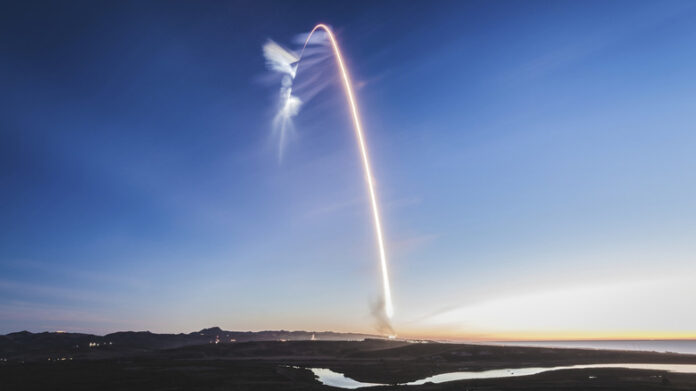
A rocket launched into space from Earth. This rocket was part of NASA’s important mission, Artemis II. After it lifted off, the rocket did not stay straight up. It started to curve as it went higher. This may look strange, but it is necessary for the rocket’s journey.
Rockets face gravity, the force that pulls things down. They start vertically to get as much speed as possible. But staying straight up uses a lot of fuel. If a rocket runs out of fuel, it could fall back to Earth. This would be dangerous for the astronauts and people below. So, rockets need to curve to save fuel and reach space.
When rockets leave the thick part of the atmosphere, they perform a gravity turn. This helps them use gravity to go faster instead of using more fuel. To stay in orbit means balancing speed and gravity. For Artemis II, the spacecraft had to do another move called the translunar injection burn to get to the moon and back safely.
What is the name of the NASA mission the rocket was part of?
Apollo 11
Artemis II
Voyager
Discovery
What force do rockets face when launched?
Magnetism
Friction
Gravity
Inertia
Why do rockets start vertically?
To look impressive
To minimize noise
To get as much speed as possible
To avoid running out of fuel
What does a gravity turn help rockets to do?
Go slower
Use fuel more efficiently
Launch without guidance
Stay straight up
What is the purpose of the translunar injection burn?
To return to Earth
To land safely
To get to the moon and back safely
To increase fuel consumption
What is necessary for a rocket's journey in space?
Curving
Staying straight up
Flying horizontally
Landing softly
The rocket stayed straight up after it lifted off.
Rockets need to curve to save fuel.
Running out of fuel is not dangerous for astronauts.
The thick part of the atmosphere helps rockets go faster.
To stay in orbit, rockets need to balance speed and gravity.
The rocket performs a gravity turn after leaving Earth's atmosphere.
A rocket is launched into space from Earth as part of NASA's important mission, Artemis II. After it lifted off, the rocket did not stay straight up; it started to curve as it went higher. This is for the rocket’s journey.
Rockets face , the force that pulls things down.
Staying straight up uses a lot of for rockets.
Rockets perform a gravity turn to use gravity to go faster instead of using more .
For Artemis II, the spacecraft had to do another move called the translunar injection burn to get to the moon and safely.
To balance speed and gravity is necessary to in orbit.
What is the name of the NASA mission the rocket was part of?
Apollo 11
Artemis II
Voyager
Discovery
What force do rockets face when launched?
Magnetism
Friction
Gravity
Inertia
Why do rockets start vertically?
To look impressive
To minimize noise
To get as much speed as possible
To avoid running out of fuel
What does a gravity turn help rockets to do?
Go slower
Use fuel more efficiently
Launch without guidance
Stay straight up
What is the purpose of the translunar injection burn?
To return to Earth
To land safely
To get to the moon and back safely
To increase fuel consumption
What is necessary for a rocket's journey in space?
Curving
Staying straight up
Flying horizontally
Landing softly
The rocket stayed straight up after it lifted off.
Rockets need to curve to save fuel.
Running out of fuel is not dangerous for astronauts.
The thick part of the atmosphere helps rockets go faster.
To stay in orbit, rockets need to balance speed and gravity.
The rocket performs a gravity turn after leaving Earth's atmosphere.
A rocket is launched into space from Earth as part of NASA's important mission, Artemis II. After it lifted off, the rocket did not stay straight up; it started to curve as it went higher. This is for the rocket’s journey.
Rockets face , the force that pulls things down.
Staying straight up uses a lot of for rockets.
Rockets perform a gravity turn to use gravity to go faster instead of using more .
For Artemis II, the spacecraft had to do another move called the translunar injection burn to get to the moon and safely.
To balance speed and gravity is necessary to in orbit.