The dwarf planet Ceres, originally classified as the first named asteroid, has more complex surface features than scientists previously believed. This conclusion comes from new research presented at the European Geosciences Union 2026 General Assembly in Vienna.
Using data from NASA’s Dawn mission, researchers found that Ceres has steep slopes, fractures, and variations in brightness that make identifying craters challenging. Since its discovery in 1801 by Italian astronomer Giuseppe Piazzi, Ceres has intrigued astronomers. In 2006, it was reclassified as a dwarf planet because of its large size and differentiated interior, which includes a core, mantle, and crust. Some scientists even suggest that it may have once harboured primitive microorganisms.
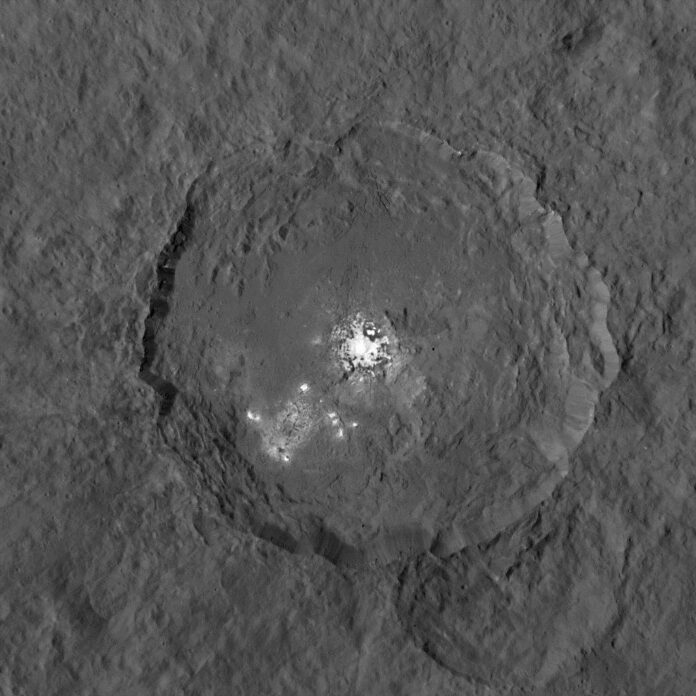
Ceres has a diameter of about 960 km, making it about a quarter the size of the Moon. Despite its relatively small size, its unique geology continues to attract interest. Recent analysis of the Occator crater region showed an unusual gravity anomaly at a depth of 50 km, indicating a reservoir of salty water, or brines, subsurface. These brines likely emerged as the result of impacts, forming bright deposits now visible on the surface.
The discovery of these bright deposits suggests recent geological activity related to cryovolcanism, where water and salt mixtures erupt at low temperatures. Scientists are exploring the possibility of future missions to Ceres, aiming to gather more detailed data that could improve our understanding of its geological history and possibly its past conditions for life.
Test Your Understanding
How much do you know?