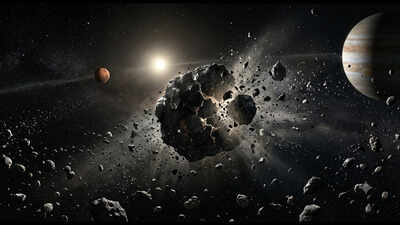
A massive asteroid that fragmented around 800 million years ago may have released numerous rocky pieces that impacted Earth, the Moon, and Mars. This finding comes from a study led by researchers at the Southwest Research Institute and is significant for understanding how early asteroid collisions influenced planetary surfaces and possibly life on Earth.
The collision likely occurred in the main asteroid belt, located between Mars and Jupiter, where millions of asteroids orbit the Sun. The shattered fragments may have caused a prolonged series of impacts across several worlds. This event could explain the large craters on the Moon that date back to the same period and may have coincided with crucial climate changes and pivotal moments in the evolution of life on Earth.
While scientists have long established that asteroid impacts have influenced planetary development, linking these events to life on Earth has proven challenging, as much evidence has eroded over time. Dr. William Bottke, a lead author of the study, noted that only the Chicxulub impact, associated with the dinosaurs’ extinction, has a clear link to life’s changes.
The Moon, lacking plate tectonics or an atmosphere, preserves impact craters far longer than Earth does. Previous studies showed a spike in large lunar impacts around 800 million years ago, informed by the age of lunar craters and samples from the Apollo missions.
The study identifies the Eulalia asteroid family as the source of the fragments. A significant collision likely shattered a carbon-rich asteroid, sending debris into the inner solar system. Researchers believe Jupiter’s gravity helped steer these pieces onto paths intersecting with Earth, leading to increased impacts over the next 100 to 150 million years.
The findings may illuminate the links between asteroid activity and climate shifts on Earth, prompting further research into their broader implications.
Test Your Understanding
How much do you know?