Tuesday, July 21, 2026

Asteroid debris from Jupiter may have pummelled Earth for 150 million years

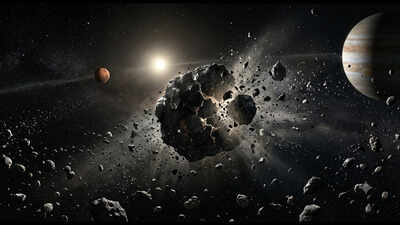
A large asteroid broke apart about 800 million years ago. This event sent many rocky pieces towards Earth, the Moon, and Mars. Scientists from the Southwest Research Institute studied this issue.

The asteroid collision likely happened in the main asteroid belt. This area is between Mars and Jupiter. It contains millions of asteroids that travel around the Sun. The fragments from the breakup may have caused many impacts on these planets over millions of years.

The researchers think this event can explain the large craters on the Moon. These craters date back to around 800 million years ago. The impacts may have also influenced Earth’s climate and the development of life.

The Moon shows many craters because it does not change much over time. Unlike Earth, it has no plate tectonics or weather to erase its surface. Scientists find it hard to study older impacts on Earth because its surface keeps changing.

The study mentions that the Eulalia asteroid family likely caused the breakup. The pieces from this incident spread out, increasing the chance of impacts on different planets, including Earth and Mars.


Test Your Understanding

Start Quiz

Vocabulary List:
6 words · tap to reveal
ON

Accent

asteroid/ˈæs.tə.rɔɪd/noun
a large rock that moves in space

fragments/ˈfræɡmənts/noun
small pieces broken from a larger object

collision/kəˈlɪʒən/noun
when two objects hit each other

craters/ˈkreɪtərz/noun
big round holes on a planet or moon

tectonics/tɛkˈtɑnɪks/noun
movement of large plates under a planet's surface

influenced/ˈɪnfluənst/verb
changed or affected something over time

How much do you know?

How long ago did the asteroid break apart?
500 million years
800 million years
1 billion years
200 million years
Which area is likely where the asteroid collision happened?
Near Earth
The main asteroid belt
Between Venus and Mercury
The Kuiper Belt
What do the fragments from the asteroid breakup explain?
Formation of new planets
Large craters on the Moon
Weather patterns on Earth
The existence of life in space
Why is it difficult to study older impacts on Earth?
They are too small to find
Earth's surface keeps changing
Earth has no craters
There is no data available
Which planets were mentioned as being impacted by the asteroid fragments?
Earth and Venus
Earth and Mercury
Earth and Mars
Earth and Jupiter
What characteristic of the Moon helps preserve its craters?
It is covered in water
It has a thick atmosphere
It has no plate tectonics or weather
It is constantly renewing its surface
The asteroid collision is believed to have occurred in the asteroid belt between Mars and Jupiter.
The fragments from the asteroid breakup only affected Earth.
Scientists have an easy time studying older impacts on the Moon.
The Eulalia asteroid family is thought to have caused the breakup.
Craters on the Moon date back to around 800 million years ago.
The breakup of the asteroid has no impact on Earth's climate.
The asteroid broke apart about million years ago.
The asteroid collision likely happened in the asteroid belt.
The fragments from the breakup may have caused many impacts on planets.
The Moon shows many craters because it does not change much over .
The pieces from this incident spread out, increasing the chance of on different planets.
Scientists find it hard to study older impacts on Earth because it has no tectonics.
This question is required

Test Your Understanding

Start Quiz
Vocabulary List:
6 words · tap to reveal
ON
Accent
asteroid/ˈæs.tə.rɔɪd/noun
a large rock that moves in space
fragments/ˈfræɡmənts/noun
small pieces broken from a larger object
collision/kəˈlɪʒən/noun
when two objects hit each other
craters/ˈkreɪtərz/noun
big round holes on a planet or moon
tectonics/tɛkˈtɑnɪks/noun
movement of large plates under a planet's surface
influenced/ˈɪnfluənst/verb
changed or affected something over time

How much do you know?

How long ago did the asteroid break apart?
500 million years
800 million years
1 billion years
200 million years
Which area is likely where the asteroid collision happened?
Near Earth
The main asteroid belt
Between Venus and Mercury
The Kuiper Belt
What do the fragments from the asteroid breakup explain?
Formation of new planets
Large craters on the Moon
Weather patterns on Earth
The existence of life in space
Why is it difficult to study older impacts on Earth?
They are too small to find
Earth's surface keeps changing
Earth has no craters
There is no data available
Which planets were mentioned as being impacted by the asteroid fragments?
Earth and Venus
Earth and Mercury
Earth and Mars
Earth and Jupiter
What characteristic of the Moon helps preserve its craters?
It is covered in water
It has a thick atmosphere
It has no plate tectonics or weather
It is constantly renewing its surface
The asteroid collision is believed to have occurred in the asteroid belt between Mars and Jupiter.
The fragments from the asteroid breakup only affected Earth.
Scientists have an easy time studying older impacts on the Moon.
The Eulalia asteroid family is thought to have caused the breakup.
Craters on the Moon date back to around 800 million years ago.
The breakup of the asteroid has no impact on Earth's climate.
The asteroid broke apart about million years ago.
The asteroid collision likely happened in the asteroid belt.
The fragments from the breakup may have caused many impacts on planets.
The Moon shows many craters because it does not change much over .
The pieces from this incident spread out, increasing the chance of on different planets.
Scientists find it hard to study older impacts on Earth because it has no tectonics.
This question is required

Read More