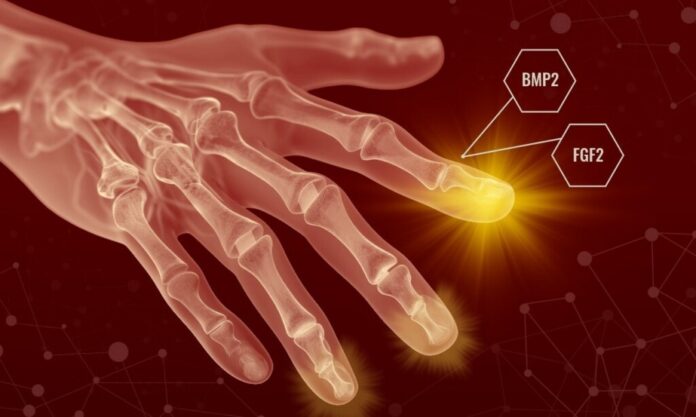
Some animals, such as salamanders, possess the remarkable ability to regenerate entire limbs. Recent scientific advancements suggest that humans may also harness innate regenerative capabilities by manipulating specific genetic mechanisms. This process involves inhibiting the typical response that leads to scar tissue formation and encouraging cells to rebuild bone, ligaments, muscle, and skin.
Dr. Ken Muneoka, a professor at Texas A&M University’s College of Veterinary Medicine and Biomedical Sciences, has dedicated his career to exploring why certain animals regenerate tissues while humans struggle to do so. In a study published in Nature Communications, Muneoka and his team introduced a novel two-step treatment that successfully led to the regeneration of bone and ligaments in mice.
In mammals, injuries usually trigger fibrosis—a rapid healing process wherein fibroblast cells seal wounds with scar tissue. This approach prioritises immediate survival but inhibits comprehensive tissue reconstruction. Conversely, species like salamanders form a blastema, a specialised structure that facilitates tissue regrowth.
The researchers tested their regenerative approach using two well-known growth factors. Initially, they applied fibroblast growth factor 2 (FGF2) after a wound healed. This allowed the body to complete its natural healing cycle before introducing a second treatment with bone morphogenetic protein 2 (BMP2) days later. This sequence inspired fibroblast cells to create new structures instead of scar tissue.
The study highlights that successful regeneration does not require external stem cells, which are often the focus in regenerative medicine. Instead, the necessary cells already exist within the body; the challenge lies in instructing them effectively. Results indicated that cells might also be reprogrammed to form structures in different locations, a process known as positional re-specification.
While the regenerated tissues were not perfect replicas of the originals, they included the essential components expected after an amputation. The research demonstrated that tissue regeneration follows multiple biological pathways, underscoring the complexity of this process.
Looking ahead, Muneoka emphasises the potential for this method to enhance healing rather than solely focus on complete regeneration. By applying these growth factors during the healing phase, it may be possible to significantly reduce scarring and improve repair outcomes. As BMP2 is approved for certain medical applications and FGF2 is in clinical trials, the transition to practical therapies may be within reach. This research marks a pivotal moment in understanding and potentially overcoming regenerative limitations in humans.
Test Your Understanding
How much do you know?