

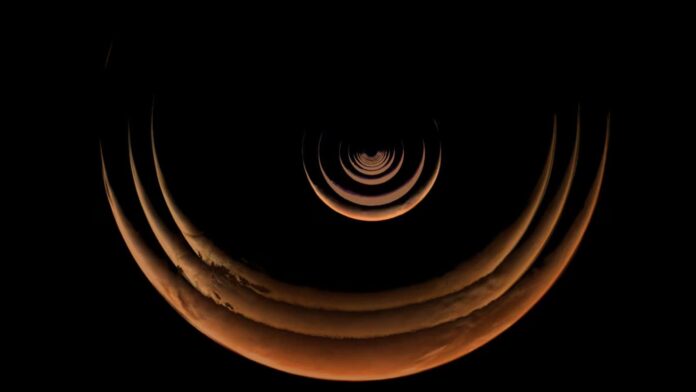
NASA’s Psyche spacecraft successfully approached Mars earlier this month, capturing stunning images of the planet while using its gravity to propel itself towards a distant metallic asteroid. This event marks a significant step in the spacecraft’s journey, vital for understanding planetary formation.
During its close encounter on May 15, Psyche flew approximately 2,900 miles above the Martian surface, executing a carefully planned gravity assist manoeuvre. This manoeuvre increased the spacecraft’s speed by about 1,000 mph and altered its trajectory towards its primary target: the enigmatic asteroid 16 Psyche, located in the outer asteroid belt.
By capitalising on this encounter, mission controllers directed Psyche to photograph Mars from unique perspectives. The resulting images showcase Mars’ polar ice caps, its wind-sculpted geological features, and crater formations in remarkable detail. NASA scientists highlighted that this successful flyby enabled them to test and calibrate the spacecraft’s scientific instruments before reaching the asteroid.
Launched in October 2023, Psyche is on a journey spanning 2.2 billion miles to reach its namesake asteroid. Scientists theorise that 16 Psyche may be the exposed metallic core of an ancient planetary building block, which could reveal crucial insights into the processes that formed rocky planets like Earth.
The spacecraft is expected to arrive at the asteroid in summer 2029, where it will undertake several years of mapping to analyse the space rock’s composition and structure. If confirmed as a fragment of a planetary core, 16 Psyche could provide scientists with an unparalleled understanding of the internal structures of terrestrial planets.
Test Your Understanding
How much do you know?



