

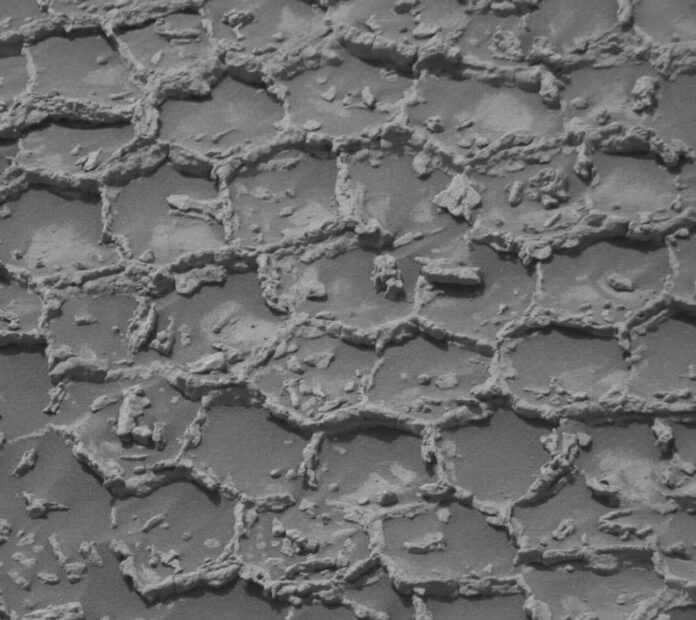
An intriguing discovery on Mars has revealed unusual polygon-shaped structures, captured in new images by NASA’s Curiosity Rover. This finding is significant as it enhances our understanding of Martian geology.
The features were located after Curiosity was sent to a specific area of Mars, previously identified by the Mars Reconnaissance Orbiter (MRO) from space. The site appeared light-coloured and smooth in orbital images, but Curiosity uncovered a strikingly different landscape.
William Farrand, a Senior Research Scientist at NASA, described the area as being “covered with polygonal structures, resembling the top of a giant Martian honeycomb.” Such polygonal shapes are common in nature and can also be seen in places like the Giant’s Causeway in Northern Ireland, which features interlocking columns of basalt.
Curiosity has made similar observations before. In May, NASA reported the discovery of honeycomb-like structures. As Curiosity explored further, it found more polygonal features, though these appeared more eroded.
Among the rocks present are dark-toned stones, which led researchers to wonder if they originated from higher strata, resulted from impacts outside Gale Crater, or are meteorite fragments. The presence of nickel in some stones is noteworthy, as it is typically rare in Martian rocks. Nickel-rich meteorites are common on Earth, suggesting these might also be meteorite fragments.
Continuing its research, Curiosity is using its APXS and MAHLI tools to investigate these peculiar features. The rover is also set to explore an area called the Miraflores butte, with ongoing plans to examine nearby dark-colored materials, which may further inform scientists about their origins.