

Friday, June 12, 2026

Physicists Uncover Slime Mold’s Decision-Making Process

Slime molds, particularly the well-studied Physarum polycephalum, exhibit intriguing behaviours that mimic intelligence despite lacking brains or nervous systems. Recent research indicates that a decentralized decision-making process governs their collective movement, challenging assumptions about central control in living organisms.

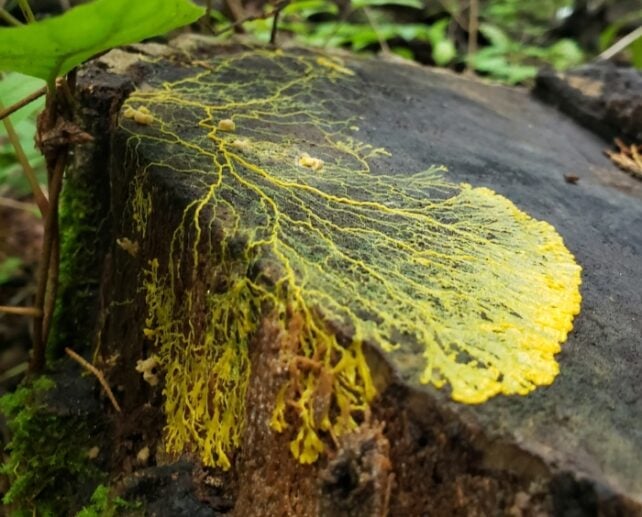
This vibrant yellow slime mold, primarily composed of a mass of cell nuclei, displays remarkable adaptability. When it exhausts available food sources, it can navigate to new locations, a feature that distinguishes it from traditional fungi. The study highlights how slime molds not only seek food but also demonstrate problem-solving abilities, such as navigating mazes to locate sustenance.

Researchers from Germany and the United States explored the mechanics behind these behaviours. They noted that P. polycephalum reacts to blue light with a strong aversion, using light traps to study its escape response. These traps consist of regions illuminated by 470 nm blue light, shaping the environment in which the molds find themselves.

During experimentation, starved slime molds began to explore these traps within an hour. They used a process known as cytoplasmic streaming, where cellular fluid flows through their bodies, enabling them to extend small structures into the illuminated regions, searching for escape routes. Most attempts were retracted, but some successful extensions allowed for liberation.

The research revealed that the longest escape routes were preferred, as the mold’s rhythmic contractions helped build pressure along these paths. This mechanical advantage enables efficient movement, suggesting that decision-making in slime molds relies more on fluid dynamics than cognitive processes.

The findings, which uncover the adaptive behaviours of non-neuronal organisms, have been published in PRX Life. Future studies may further elucidate how these fascinating creatures process their environments to survive.

Test Your Understanding

Start Quiz

Vocabulary List:
6 words · tap to reveal
ON

Accent

decentralized/diːˈsɛntrəˌlaɪzd/adjective
not controlled by a single person or group

collective/kəˈlɛktɪv/adjective
done by or shared by a whole group

adaptability/əˌdæptəˈbɪlɪti/noun
ability to change and work well in new situations

navigate/ˈnævɪˌɡeɪt/verb
to find a way to move through a place

aversion/əˈvɝʒən/noun
a strong dislike or wish to avoid something

cytoplasmic/ˌsaɪtəˈplæzmɪk/adjective
relating to the fluid inside a cell

How much do you know?

What is the scientific name of the well-studied slime mold mentioned?
Amoeba proteus
Physarum polycephalum
Aspergillus niger
Penicillium chrysogenum
What do slime molds lack despite their ability to mimic intelligence?
Cell nuclei
Brains or nervous systems
Decentralized decision-making
Collective movement
How do slime molds react to blue light?
They are attracted to it
They have no response
They exhibit strong aversion
They glow
What mechanism do slime molds use to explore light traps?
Cytoplasmic streaming
Mitosis
Photosynthesis
Binary fission
What is the preferred type of escape routes for slime molds?
Shortest paths
Simplest routes
Longest escape routes
Circular paths
Where were the findings about slime molds published?
Nature
Science
PRX Life
Cell
Slime molds are classified as traditional fungi.
The behavior of slime molds challenges assumptions about central control in living organisms.
Slime molds possess a nervous system for decision making.
Researchers discovered that slime molds can navigate mazes to find food.
Cytoplasmic streaming refers to the rigid movement of slime molds.
The study indicates that decision-making in slime molds is based on cognitive processes.
Slime molds exhibit behaviors that mimic intelligence despite lacking .
When they run out of food, slime molds can navigate to locations.
The slime mold reacts to blue light by exhibiting aversion.
The exploration of light traps by starved slime molds occurs within hour.
Slime molds prefer the longest escape routes due to their rhythmic contractions.
Research findings about slime molds were published in Life.
This question is required

Test Your Understanding

Start Quiz
Vocabulary List:
6 words · tap to reveal
ON
Accent
decentralized/diːˈsɛntrəˌlaɪzd/adjective
not controlled by a single person or group
collective/kəˈlɛktɪv/adjective
done by or shared by a whole group
adaptability/əˌdæptəˈbɪlɪti/noun
ability to change and work well in new situations
navigate/ˈnævɪˌɡeɪt/verb
to find a way to move through a place
aversion/əˈvɝʒən/noun
a strong dislike or wish to avoid something
cytoplasmic/ˌsaɪtəˈplæzmɪk/adjective
relating to the fluid inside a cell

How much do you know?

What is the scientific name of the well-studied slime mold mentioned?
Amoeba proteus
Physarum polycephalum
Aspergillus niger
Penicillium chrysogenum
What do slime molds lack despite their ability to mimic intelligence?
Cell nuclei
Brains or nervous systems
Decentralized decision-making
Collective movement
How do slime molds react to blue light?
They are attracted to it
They have no response
They exhibit strong aversion
They glow
What mechanism do slime molds use to explore light traps?
Cytoplasmic streaming
Mitosis
Photosynthesis
Binary fission
What is the preferred type of escape routes for slime molds?
Shortest paths
Simplest routes
Longest escape routes
Circular paths
Where were the findings about slime molds published?
Nature
Science
PRX Life
Cell
Slime molds are classified as traditional fungi.
The behavior of slime molds challenges assumptions about central control in living organisms.
Slime molds possess a nervous system for decision making.
Researchers discovered that slime molds can navigate mazes to find food.
Cytoplasmic streaming refers to the rigid movement of slime molds.
The study indicates that decision-making in slime molds is based on cognitive processes.
Slime molds exhibit behaviors that mimic intelligence despite lacking .
When they run out of food, slime molds can navigate to locations.
The slime mold reacts to blue light by exhibiting aversion.
The exploration of light traps by starved slime molds occurs within hour.
Slime molds prefer the longest escape routes due to their rhythmic contractions.
Research findings about slime molds were published in Life.
This question is required

Read More