Warning: foreach() argument must be of type array|object, false given in /home/u750883576/domains/esl-news.com/public_html/wp-content/plugins/gpt-post-quiz/includes/admin/class-gpoq-admin-4.php on line 450
Warning: foreach() argument must be of type array|object, false given in /home/u750883576/domains/esl-news.com/public_html/wp-content/plugins/td-composer/legacy/common/wp_booster/td_menu.php on line 88
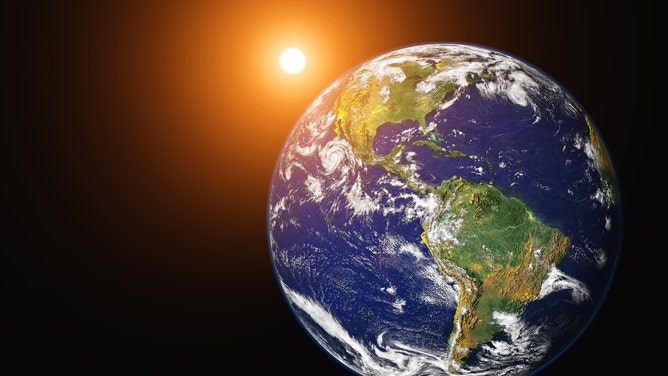
A recent study published in Astronomy and Astrophysics offers new insights into what will happen to Earth when the Sun eventually dies. This development is important as it challenges long-held views about our planet’s fate.
In about five billion years, the Sun will exhaust its fuel and expand into a red giant, a stage marking the end of its life. For years, scientists believed this would result in the destruction of Mercury, Venus, and Earth. However, the new research indicates that Earth’s future may depend on two key scenarios.
The first factor is the strength of the Sun’s gravitational tidal interactions, which influence how the planets orbit. Earth may either be pulled in and consumed by the expanding Sun or drift to a wider orbit. The second factor is the Sun’s mass-loss rates. If these rates are low, Earth could be engulfed; if high, our planet might manage to survive.
AGB, or Asymptotic Giant Branch, describes the more explosive phase of the red giant stage, during which the Sun will violently shed its outer layers into space. The study notes that uncertainty remains around these mass-loss rates, leaving Earth’s final fate ambiguous.
Researchers studied a nearby star, L2 Pup, which resembles what the Sun will become. By observing L2 Pup, they measured how much mass this star is currently losing, allowing them to reconsider Earth’s chances of survival.
While this research brings a sense of hope, it ultimately underscores that humanity will face significant challenges as the Sun enters its final phases.