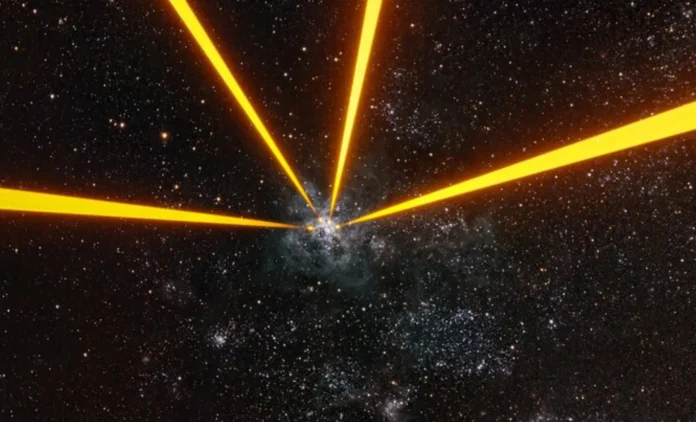
A recent image from the European Southern Observatory’s Very Large Telescope Interferometer shows four bright laser beams piercing the night sky. This striking visual is linked to a significant advancement in how scientists study the universe. These lasers are essential for tackling one of astronomy’s oldest problems: the disrupting effects of Earth’s turbulent atmosphere.
At first sight, the scene may resemble something from a science fiction film. However, these lasers create what astronomers call artificial guide stars high above the Earth. The lasers excite sodium atoms about 90 kilometers up, producing bright reference points that telescopes can follow. As light from far-off celestial objects shifts while passing through the atmosphere, these stars help scientists measure this distortion accurately.
Advanced adaptive optics systems come into play next. By using complex algorithms and extremely fast mirrors, telescopes adjust their optics hundreds of times every second. This process cancels out the atmospheric blur, yielding images that rival those captured by space-based telescopes, all while remaining on the ground.
The Very Large Telescope Interferometer is situated in Chile’s Atacama Desert, known for its exceptionally clear skies, making it ideal for advanced research. This system combines four telescopes into one powerful instrument, significantly enhancing observational precision since adding the Four Laser Guide Star Facility in 2016.
With this technology, astronomers can study distant celestial structures, such as the Tarantula Nebula, in unprecedented detail. By correcting atmospheric interference, they can uncover finer information about stars, planets, and galaxies, leading to a deeper understanding of the universe’s evolution.
Test Your Understanding
How much do you know?