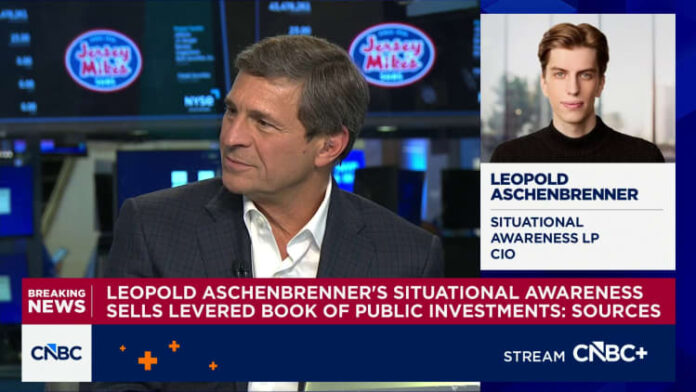
Two years ago, Leopold Aschenbrenner claimed he had a clear vision of the future of artificial intelligence (AI). His extensive 165-page essay, which gained notoriety in Silicon Valley, portrayed him as a visionary predicting the onset of artificial superintelligence. However, this week, the limitations of his foresight became evident as his AI-focused hedge fund, Situational Awareness, faced significant financial turmoil due to falling semiconductor stocks and Wall Street’s margin calls.
At its highest valuation earlier this month, the fund managed $45 billion in assets. By Thursday, however, after unloading all leveraged stock positions—including those in struggling companies like SK Hynix and CoreWeave—to Citadel at a reduced price, its assets diminished to approximately $10 billion, according to informed sources.
Aschenbrenner’s rapid ascent and subsequent decline have attracted attention from both Wall Street and the technology sector, marking him as the most notable victim of the current AI investment volatility. A polarising figure, he has drawn a substantial following online, with admirers viewing him as a potential genius while scrutinising his background. Prior to this month’s downturn, Situational Awareness had recorded gains exceeding 1,000% since its inception.
Critics highlighted Aschenbrenner’s lack of investment experience prior to launching the fund in July 2024, suggesting his success relied more on luck than skill. Reports indicated that Situational Awareness employed leverage as high as 400%, leading some in finance to predict the fund’s collapse. One analyst remarked that many anticipated this failure as a matter of timing rather than possibility.
The near collapse of Situational Awareness coincided with Aschenbrenner’s upcoming wedding, planned for this weekend. He is engaged to Avital Balwit, a senior executive at Anthropic, a prominent AI company.
Test Your Understanding
How much do you know?