

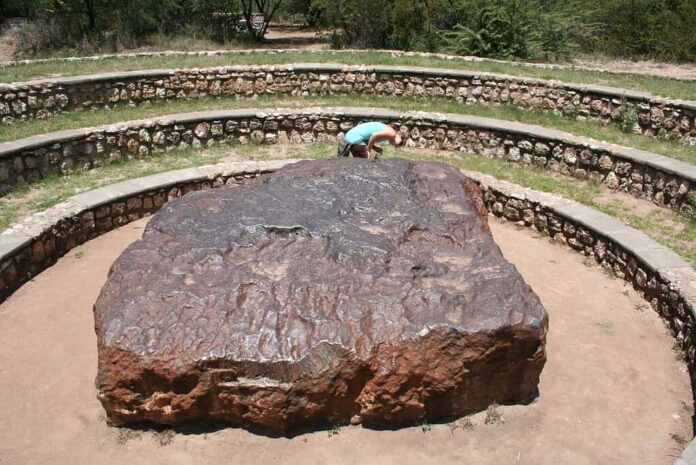
The Hoba meteorite, located in Namibia, is the largest known natural iron object on Earth, weighing approximately 60 metric tons. Despite its size and the belief that such a large meteorite should have created a crater upon impact, it surprisingly did not leave one. Approximately 80,000 years ago, it entered the Earth’s atmosphere but slowed down significantly due to its unique composition and shape, as well as its shallow entry angle.
The meteorite remains exactly where it fell, on a farm near Grootfontein. Its discovery in 1920 by Jacobus Hermanus Brits was somewhat accidental, as he struck the metal mass while ploughing. Initially, only a portion of the Hoba meteorite was visible above ground, with subsequent excavations revealing its enormous rectangular shape buried beneath a light soil cover.
Scientists have classified it as an “ataxite,” a type of iron meteorite high in nickel content. This material, along with the meteorite’s unique slab-like shape, contributed to its survival during atmospheric entry. Hoba likely weighed around 500 metric tons when it entered the atmosphere, losing almost 90% of its mass due to friction and heat.
The absence of a visible crater today may be due to erosion and the meteorite’s relatively slow landing. Over the years, human activity and natural weathering have affected its mass, prompting efforts to protect the site since it was declared a national monument in 1955. Moving forward, ongoing protection measures will be essential to preserve this significant astronomical artifact.


