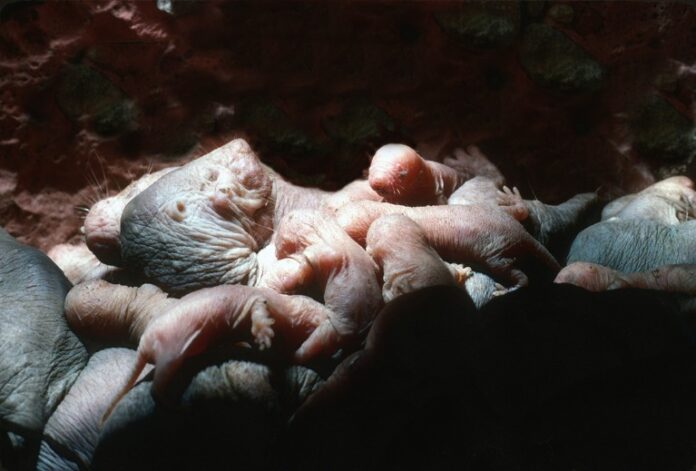
Naked mole-rat queens release a chemical that stops other females in their colony from reproducing. A study published in Nature reveals that this compound helps maintain a strict social order led by a single queen, even when she is absent. The chemical influences hormone production in other females, reducing their ability to have offspring.
This research is significant, according to Melissa Holmes, a behavioural neuroscientist at the University of Toronto. She notes it addresses a puzzling question: why only one female in a naked mole-rat colony reproduces.
Naked mole-rats are known for their resilience and long lifespan. They exhibit eusocial behaviour, which is rare in mammals. In this social structure, the queen is solely responsible for reproduction, while other sterile females care for the young and perform tasks like foraging for food.
Despite the potential for all females to become queens, many remain in a “stalled puberty phase,” as noted by Lisa Stowers, a neuroscientist at Scripps Research. In this state, their reproductive organs remain underdeveloped, and levels of the hormone prolactin are high. The mystery of how one queen maintains her dominance has intrigued scientists.
To uncover the truth, Mohammed Khallaf and his team from the Max Delbrück Center in Berlin studied the chemical scents produced by naked mole-rats of different social ranks. They found a compound called isopropyl myristate (IPM) predominantly in queens. Its production varied with the queen’s reproductive cycle, peaking during ovulation.
Further experiments showed that exposure to IPM activated smell-sensitive neurons in non-breeding females. When these females were isolated or had their sense of smell blocked, their prolactin levels dropped, allowing for potential mating. Notably, even in the queen’s absence, IPM alone could prevent reproduction and uphold the colony’s social hierarchy.