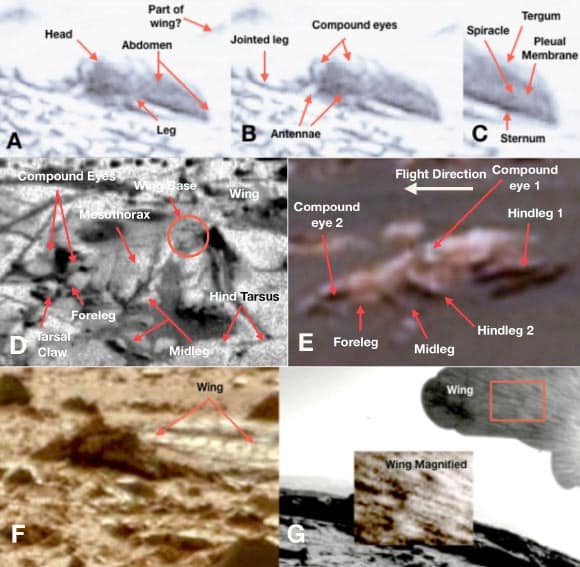
The Curiosity rover on Mars has captured images that some researchers suggest show insect-like and reptile-like creatures on the planet’s surface. William Romoser, an entomologist with a long career studying insects, has analysed these images extensively. He believes they show creatures in flight and evidence of a diverse ecosystem, including insects and fossils of reptile-like organisms in Gale Crater.
Romoser presented his analysis at the Entomological Society of America’s 2019 meeting, highlighting features like compound eyes and wing structures in the rover’s images. He describes one sequence depicting an insect performing a flight manoeuvre similar to those seen on Earth. Romoser also claims certain fossils display characteristics of predatory reptiles, implying these creatures could prey on smaller insect-like forms.
However, Romoser’s findings have sparked debate. While they open new avenues for research in astrobiology, some scientists argue that his interpretations are not supported by strong evidence. Curiosity’s main mission is to search for signs of microbial life, with findings so far indicating ancient water systems and organic molecules, but no confirmation of larger life forms.
Researchers often refer to pareidolia, a psychological phenomenon where the brain sees familiar patterns in random shapes, as an explanation for claims of Martian life. Many believe the images interpreted as insect-like creatures may simply be geological formations that, from certain angles, appear biological. The rover continues to explore Gale Crater, capturing detailed images of the Martian landscape.
Test Your Understanding
How much do you know?