Warning: foreach() argument must be of type array|object, false given in /home/u750883576/domains/esl-news.com/public_html/wp-content/plugins/gpt-post-quiz/includes/admin/class-gpoq-admin-4.php on line 450
Warning: foreach() argument must be of type array|object, false given in /home/u750883576/domains/esl-news.com/public_html/wp-content/plugins/td-composer/legacy/common/wp_booster/td_menu.php on line 88
Dementia affects millions globally and remains hard to treat. Scientists have found a potential new target for future treatments. They slowed dementia in mice using this discovery.
The target is an enzyme called G protein-coupled receptor kinase 2 (GRK2), important for cell health. GRK2 helps cells handle stress. Researchers found a faulty version of GRK2 that may relate to dementia.
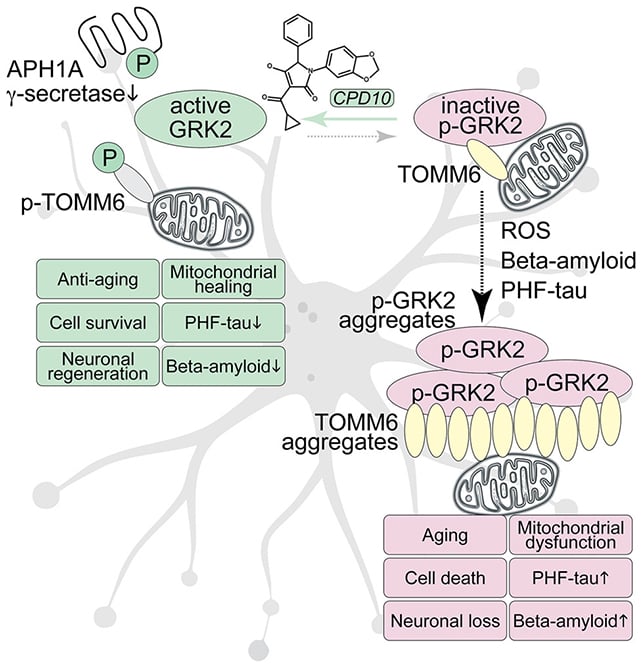
This inactive GRK2 gathers around mitochondria, which are vital cell parts often linked to Alzheimer’s disease. A team at ETH Zurich in Switzerland studied the connection between GRK2 and dementia.
They found a lot of inactive GRK2 in the brain cells of both mice and humans with Alzheimer’s. In mice, it also increased amyloid-beta protein, associated with this disease.
Inactive GRK2 builds up like amyloid beta and harms mitochondria, causing stress in brain cells. This creates a harmful cycle, worsening the problem.
The researchers developed a compound called Compound 10. It stops inactive GRK2 from clumping, helping mitochondria work better and reducing amyloid beta. In mice, this slowed dementia’s progress.
While more research is needed, including on human samples, results are promising. GRK2 was not deeply studied in Alzheimer’s before. Researchers say GRK2 could offer new ways to address the complex disease. The study was published in Cell Reports Medicine.
What enzyme is identified as a potential target for dementia treatment?
GRK1
GRK2
GRK3
GRK4
Which institution conducted the study on GRK2 and dementia?
Harvard University
ETH Zurich
Stanford University
Oxford University
What is the function of GRK2 in cells?
To promote cell division
To handle stress
To enhance cell motility
To regulate cell death
What compound did researchers develop to help with GRK2 inactivity?
Compound 1
Compound 5
Compound 10
Compound 20
What harmful protein is associated with Alzheimer's disease that increased in mice?
Tau protein
Neurofibrillary tangles
Amyloid-beta
Cerebral amyloid angiopathy
Is more research needed on human samples regarding GRK2's effects on dementia?
Yes
No
Inactive GRK2 has a beneficial effect on mitochondria.
The study on GRK2 and dementia was published in Cell Reports Medicine.
GRK2 is known to promote Alzheimer’s disease.
The researchers found an active version of GRK2 in the brain cells of Alzheimer’s patients.
Compound 10 assists in preventing inactive GRK2 from clumping.
Dementia only affects a small number of individuals globally.
Dementia affects millions globally and remains hard to treat. Scientists have found a potential new target for future treatments, specifically an enzyme called GRK2, which is important for cell health. GRK2 helps cells handle .
Inactive GRK2 gathers around mitochondria, which are vital cell parts often linked to disease.
In the brain cells of mice and humans with Alzheimer's, researchers found a lot of GRK2.
Inactive GRK2 builds up like amyloid beta and harms mitochondria, causing stress in brain .
The researchers developed a compound called Compound 10, which stops inactive GRK2 from clumping and helps work better.
While more research is needed, including on human samples, results from the study were very .
What enzyme is identified as a potential target for dementia treatment?
GRK1
GRK2
GRK3
GRK4
Which institution conducted the study on GRK2 and dementia?
Harvard University
ETH Zurich
Stanford University
Oxford University
What is the function of GRK2 in cells?
To promote cell division
To handle stress
To enhance cell motility
To regulate cell death
What compound did researchers develop to help with GRK2 inactivity?
Compound 1
Compound 5
Compound 10
Compound 20
What harmful protein is associated with Alzheimer's disease that increased in mice?
Tau protein
Neurofibrillary tangles
Amyloid-beta
Cerebral amyloid angiopathy
Is more research needed on human samples regarding GRK2's effects on dementia?
Yes
No
Inactive GRK2 has a beneficial effect on mitochondria.
The study on GRK2 and dementia was published in Cell Reports Medicine.
GRK2 is known to promote Alzheimer’s disease.
The researchers found an active version of GRK2 in the brain cells of Alzheimer’s patients.
Compound 10 assists in preventing inactive GRK2 from clumping.
Dementia only affects a small number of individuals globally.
Dementia affects millions globally and remains hard to treat. Scientists have found a potential new target for future treatments, specifically an enzyme called GRK2, which is important for cell health. GRK2 helps cells handle .
Inactive GRK2 gathers around mitochondria, which are vital cell parts often linked to disease.
In the brain cells of mice and humans with Alzheimer's, researchers found a lot of GRK2.
Inactive GRK2 builds up like amyloid beta and harms mitochondria, causing stress in brain .
The researchers developed a compound called Compound 10, which stops inactive GRK2 from clumping and helps work better.
While more research is needed, including on human samples, results from the study were very .